That's exactly the problem corporate film production solves. A well-made corporate video communicates what text simply can't — your people, your culture, your competence — in minutes.
This guide covers everything you need to know: what a corporate film actually is, why it matters for business growth, how production works from brief to delivery, and how to find the right production partner for your project.
Key Takeaways
- Corporate films are non-advertisement business videos — brand overviews, testimonials, training films, and more — distributed primarily online
- 89% of consumers want more brand video, and 85% say video influenced a product or service purchase
- Pre-production is where most corporate films succeed or fail — rushing it costs money downstream
- Audio quality and authentic performances matter more than production flash — poor production values erode audience trust faster than a weak message
- The right production partner brings portfolio depth, end-to-end capabilities, and a process that fits your specific project — not a cookie-cutter template
What Is a Corporate Film?
EVCOM defines a corporate film as "any type of non-advertisement based film content created for and commissioned by a business, company, corporation, or organization." That definition matters because it draws a clear line between corporate film and broadcast advertising — two categories that share production equipment but serve very different purposes.
Corporate Films vs. TV Commercials
A TV commercial is designed for paid broadcast placement, must clear compliance requirements, and typically carries a higher production budget to match. A corporate film is produced for digital distribution — your website, LinkedIn, YouTube, email campaigns — with communication goals that go beyond direct advertising. That distinction shapes everything: the creative brief, the run time, the tone, and the budget conversation.
Who Corporate Films Are Made For
Corporate films serve two distinct audience groups, and the format shifts depending on which one you're addressing:
- External audiences — customers, prospects, investors, and partners who need to understand your value, culture, or offer
- Internal audiences — employees, new hires, and contractors who need training, safety information, or alignment on company values
A brand overview video for your website looks and sounds nothing like a safety orientation video for industrial contractors. Both are corporate films — neither is a commercial.
Common Types of Corporate Films
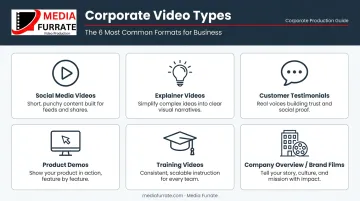
The most commonly produced business video types include:
- Social media videos — short-form content for LinkedIn, Instagram, and similar platforms
- Explainer videos — product or service breakdowns that simplify complex offerings
- Customer testimonials — real clients describing real results
- Product demos that show how something works in practice, not just on paper
- Training videos — onboarding, safety orientation, compliance, and skill development
- Company overview / brand films — the "who we are" video on your website or pitch deck
Media Furrate, for instance, identifies industrial safety orientation videos as among the most frequently produced in their portfolio — a format that requires tight scriptwriting and coordination with legal teams to ensure compliance messaging lands clearly.
The format you choose depends entirely on what you need the audience to do — or understand — after watching.
Why Corporate Film Production Matters for Your Business
Audience Preference Is Decisive
Wyzowl's 2024 data shows 89% of people want to see more video from brands, and a TechSmith study found 83% prefer video for instructional or informational content — a preference that holds across both marketing and training contexts. For businesses still relying primarily on text, that gap is worth taking seriously.
Video Influences Purchase Decisions
A well-produced product explainer or testimonial video can move prospects in ways a spec sheet never will. Wyzowl's 2024 data shows 85% of consumers were convinced to buy a product or service after watching a video, with 77% specifically convinced to purchase software or an app after watching a brand video.
Place the right video at the right point in your sales funnel, and it does the persuasion work for you.
Trust Comes From Showing, Not Telling
Documentary-style corporate films — where real people speak naturally about their work — tend to outperform scripted "talking head" formats on trust. HubSpot's 2024 research found 63% of consumers prefer relatable, authentic video over polished, high-production-value content.
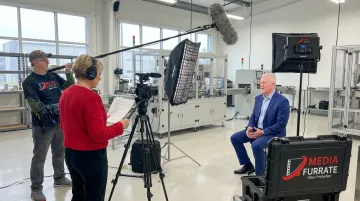
This is why Media Furrate's organic interview approach, where Jason stands just off-camera and lets business owners speak conversationally for 12-20 minutes, consistently produces material that feels genuine. No script. No performance pressure. Just a real person talking about what they know.
Search Visibility and Digital Distribution
Google Search Central documents how indexable video content can become eligible for video features in search results, creating an additional discovery channel beyond standard web pages. Wyzowl's 2024 data shows 82% of marketers say video increased website dwell time — a signal that matters for on-site engagement.
YouTube, with billions of monthly logged-in users and over 200 billion daily Shorts views, represents a distribution channel many businesses underuse entirely.
The Competitive Gap
91% of businesses now use video as a marketing tool. At that level of adoption, the question shifts from whether to use video to whether yours is good enough to stand out. A high-quality corporate film positions a business as credible and professional. A poorly executed one does the opposite.
The Corporate Film Production Process: Step by Step
Pre-Production: Where the Real Work Happens
Pre-production determines everything downstream. Rushing it is the most common and most costly mistake businesses make.
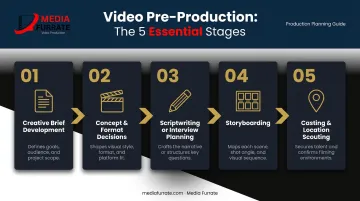
A thorough pre-production phase covers:
- Creative brief development: defining target audience, core message, intended platform, and budget parameters. At Media Furrate, this starts with a single question: What is your message, and what is the most effective way to deliver it to the right audience?
- Concept and format decisions: scripted production, documentary-style interview, animation, or a combination
- Scriptwriting or interview planning: for scripted productions, a written script the client can review and approve; for documentary-style, a planned conversation structure without a formal script
- Storyboarding: mapping out what the audience will see and hear, shot by shot
- Casting and location scouting: identifying on-camera subjects and confirming shoot locations
Jason Furrate has written scripts for 99% of over 10,000 productions since 1978. That track record, combined with research through phone surveys, focus groups, and real-time audience testing, means pre-production at Media Furrate is grounded in how audiences actually process messages on screen — not just creative instinct.
Production: Executing the Plan
Once pre-production wraps, the shoot translates that plan into usable footage. A typical production day includes:
- Capturing interviews and performances aligned with the intended message
- Shooting b-roll — environmental footage that gives editors something dynamic to cut to beyond a talking subject
- Aerial footage via FAA-licensed drone where facility scale, geography, or event coverage warrants it
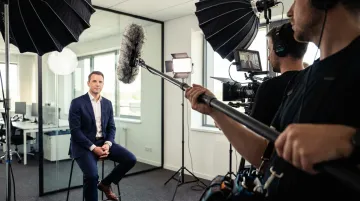
- Recording clean, professional-grade audio — poor sound quality undermines even strong visuals
Media Furrate's LEAN production model keeps crew sizes as small as possible during this phase — minimizing cost, reducing logistical complexity, and limiting the variables that can slow a shoot down without compromising the final product.
Post-Production: Where Raw Footage Becomes a Story
The editorial process is where disconnected footage becomes a coherent story. That involves:
- Assembling and selecting the best footage from the shoot
- Pacing cuts to maintain momentum and emotional rhythm
- Color grading for visual consistency and polish
- Sound design and music selection matched to the video's tone
- Motion graphics, lower thirds, and title cards where needed
- Voiceover recording when applicable
Courtney Lawrence handles the Producer/Editor role at Media Furrate, working alongside the production team to ensure each finished piece communicates the client's message with clarity and cohesion.
Review, Revisions, and Delivery
Collecting consolidated feedback from all stakeholders — rather than fielding notes from multiple people in separate conversations — keeps revisions targeted and prevents scope creep.
Once the final cut is approved, delivery means exporting files optimized for each platform: website, LinkedIn, YouTube, email campaigns, or internal systems. A finished film with no distribution plan reaches no one — which is why knowing where the video will live is a pre-production decision, not a final-step afterthought. When each phase is executed well, the result is a finished piece that serves a clear purpose and reaches the right audience.
What Makes a Corporate Film High-Impact?
One Clear Message
Films that try to say everything end up saying nothing. High-impact corporate films are built around a single focused idea. Every visual, line of dialogue, and graphic supports one central message. If your brief includes five different business objectives, your first job is to pick one.
Authentic Performances
Scripted, overly produced "talking head" videos often feel stiff, and audiences notice. The most effective corporate films feature real people speaking naturally — whether you're filming a CEO statement or a customer testimonial.
Visuals matter as much as the speaker. Key production elements that elevate authenticity include:
- Strong b-roll and cinematic composition that holds attention between interview moments
- Professional lighting that flatters subjects without looking over-produced
- Aerial drone footage for industrial or facilities-based businesses, which adds scale that ground-level cameras can't match
Production Quality — Especially Audio
Poor audio is the single fastest way to lose an audience. TechSmith's 2024 research found that among viewers who stopped watching due to quality problems, blurry footage and poor audio were tied as the top deal-breakers. The same study found 35% of viewers say high-quality, easy-to-hear narration keeps them engaged.
Wyzowl's late-2025 survey puts a finer point on it: 89% of consumers say video quality affects their trust in a brand. Sound quality isn't cosmetic — it's a credibility issue.
A Call to Action That Fits
Every corporate film should give the viewer a clear next step. The CTA should feel like a natural conclusion to the story, not a hard sell tacked on at the end.
Common CTAs that convert well include:
- Visiting a product or services page
- Scheduling a consultation or demo
- Contacting a sales team directly
Wistia data shows video CTAs carry an average conversion rate of around 16% across their platform.
How to Choose the Right Corporate Film Production Company
Evaluate Portfolio and Fit
Look beyond visual quality. Review whether past productions communicate clearly and feel authentic to the brands they represent. A company that has worked in your industry — healthcare, industrial, professional services — will understand the regulatory, cultural, and messaging context your project requires.
Key criteria to assess:
- Do their past films look and sound like what you need?
- Have they worked with businesses of similar size and complexity?
- Do the films feel authentic, or do they feel produced?
Assess End-to-End Capabilities
The best production partners handle the full process — concept, scripting, shooting, editing, motion graphics, and final delivery — under one accountable team. Coordinating across multiple vendors adds cost, communication risk, and timeline complexity.
Look for partners who are transparent about their process and crew structure. Media Furrate, for example, uses a LEAN production approach that keeps crews small and costs manageable without sacrificing quality. With 45+ years and 10,000+ productions behind them, they've applied this model for clients across the Southeastern United States.
Check Creative and Technical Range
Depending on your project, you may need more than a camera crew. Before committing, confirm whether the company offers:
- FAA-licensed drone pilots for aerial footage of facilities, events, or campuses
- Documentary-style interview expertise for authentic, unscripted content
- In-house motion graphics for explainers or animated sequences
- Studio access when location shooting isn't practical
Before you start conversations with any production company, define your objectives, video type, and ballpark budget. Limit your shortlist to no more than six firms, and review revision provisions before signing anything.
Frequently Asked Questions
What is a corporate film?
A corporate film is any non-advertisement video content created for a business or organization — including brand overviews, training videos, testimonials, product explainers, investor pieces, and more. It's designed to communicate with external audiences (customers, partners, investors) or internal ones (employees, contractors), and is distributed primarily online.
How long should a corporate film be?
Length depends on purpose and platform. Brand and social videos typically perform best under two minutes, while training or explainer content can run longer when the subject requires it. Shorter is more effective — if you can say it in 90 seconds, don't use five minutes.
How much does corporate film production cost?
Costs vary based on scope, shoot days, locations, crew size, talent, and post-production complexity. Primary drivers include preparation and planning, crew time and labor, any on-camera talent, and the editing and finishing work.
What is the difference between a corporate film and a commercial?
Commercials are produced for paid broadcast placement, carry strict technical specifications, and typically require significantly higher production budgets. Corporate films are produced for digital distribution — websites, social media, email — and serve communication goals beyond direct advertising.
What types of businesses need corporate films?
Any business that needs to communicate its value, culture, products, or services to an audience. Healthcare organizations, industrial companies, professional services firms, non-profits, retailers, PR agencies, and event-driven organizations all produce corporate films regularly for both external marketing and internal communications.