
Most businesses understand this in principle. The harder question is what separates a testimonial video that genuinely builds trust and drives decisions from one that feels hollow, stilted, or forgettable. After 45+ years and over 10,000 productions, the team at Media Furrate has a clear view of what that difference looks like — and it comes down to a handful of specific, learnable elements.
Key Takeaways
- Strong testimonial videos follow a three-part arc: problem, solution, measurable result
- Unscripted, conversational responses consistently outperform rehearsed ones
- Bad audio damages credibility more than imperfect visuals — keep technical quality tight
- Choosing the right subject and preparing effective questions matters as much as the shoot itself
- Editing for pacing and length is what transforms raw footage into something viewers actually finish
Why Testimonial Videos Are One of Your Most Powerful Marketing Tools
People don't trust brands — they trust other people. That's not an opinion; Nielsen research found that 88% of global consumers trust recommendations from people they know more than any other channel, with 50% more people trusting peer recommendations than online banner ads or search ads. A testimonial video captures that dynamic on screen.
The practical impact shows up across the entire buyer journey. According to Wyzowl's 2026 State of Video Marketing report, 85% of people have been convinced to buy a product or service after watching a video, and 82% of marketers say video has delivered a good ROI.
These figures cover video broadly, but testimonials are uniquely positioned to convert. They combine social proof with emotional connection in a format that written reviews simply can't match.
There's also a practical efficiency argument. A single well-produced testimonial can be:
- Embedded on a landing page or product/service page
- Cut into shorter clips for social media
- Used in email campaigns and sales outreach
- Included in pitch decks and proposals
That kind of reach across multiple channels makes a testimonial video one of the highest-return pieces of content a business can invest in. Adoption reflects this: Wistia's 2026 State of Video Report found that planned creation of customer testimonial videos jumped from 17% of companies in 2023 to 47% by 2026. If you haven't made testimonials a core part of your content strategy yet, your competitors likely already have.
The Story Structure Every Great Testimonial Video Follows
A testimonial without structure is just a collection of compliments. What makes a video genuinely persuasive is a narrative arc — one the viewer can follow and, more critically, see themselves inside.
The Three-Part Arc
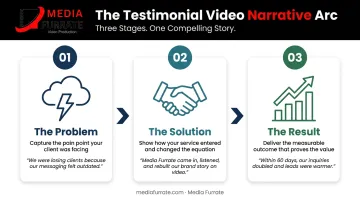
Every effective testimonial video follows the same basic framework:
The Problem opens the story. The customer describes the challenge they faced before finding your product or service — this is where viewers self-identify. Without a relatable "before," nothing that follows has stakes. It doesn't have to be dramatic, just real and recognizable.
The Solution covers why they chose your company and what working with you actually felt like. This is where brand trust gets built. It's not about listing features; it's about the experience of making that decision.
The Result is where most testimonials fall short. Vague praise like "they were great to work with" gives potential buyers nothing to hold onto. Specific outcomes do. "Our lead volume increased 40% in the first three months" is a fundamentally different claim than "things really improved." Specificity signals credibility — a specific number tells the viewer this person is recalling a real experience, not performing one.
How Long Should It Be?
For most use cases, 60 seconds to 3 minutes is the optimal range. Wistia's research found that testimonial videos under one minute average a 46% engagement rate — meaningful, but often not enough time for the full arc to land.
Longer testimonials can work when the story demands it. The length should follow the content, not a template. Padding a thin story to two minutes is worse than a tight 90-second version.
Authenticity: The Element That Makes or Breaks Your Testimonial
Viewers are good at detecting when something feels coached. A slick, over-rehearsed testimonial doesn't just fail to build trust. The performance itself raises questions about whether any of it is real — and that erosion is hard to recover from.
Why Scripts Kill Testimonials
When a subject memorizes answers, the signs show up immediately on screen:
- Eye contact goes slightly off — they're recalling lines, not speaking naturally
- Emotional pacing becomes flat and uniform
- Specific details get smoothed out and replaced with general praise
- The small imperfections that signal genuine memory disappear
Natural speech has rhythm, hesitation, and specificity that rehearsed speech doesn't. Those qualities are exactly what makes a testimonial feel credible.
The Documentary-Style Interview Approach
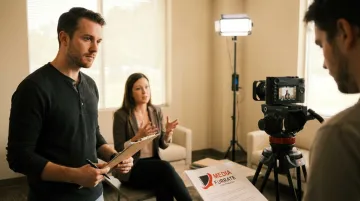
The approach Media Furrate has refined across thousands of productions works differently. Rather than scripting answers, the producer stands just to the side of the camera, maintaining eye contact with the subject instead of having them stare into a lens, and guides the conversation through questions asked in a relaxed, natural way. The subject talks. The camera captures it.
Typical interview sessions run 12–20 minutes — long enough to gather everything needed without making the subject feel rushed or put on the spot.
This draws on Jason Furrate's background conducting focus groups and real-time audience testing. The goal isn't to elicit a perfect performance; it's to create conditions where genuine, specific responses emerge on their own.
What Helps Subjects Relax
A few things make a real difference before the camera even rolls:
- A casual conversation about what to expect (not rehearsal — just orientation)
- Choosing a location that feels natural to the subject, not just convenient for the crew
- Framing questions as conversation, not examination
Minor pauses, a genuine laugh, a moment where the subject searches for the right word — these actually strengthen the video. They're what make it believable.
The Technical Essentials: Audio, Lighting, and B-Roll
Even a compelling story can fall apart if the production quality signals carelessness. Wyzowl found that 89% of consumers say video quality directly impacts their trust in a brand. Viewers associate the quality of the video with the quality of the business it represents.
Lighting and Framing
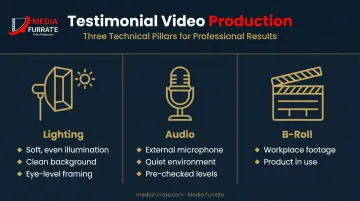
Poor lighting undermines viewer trust faster than almost anything else. Harsh shadows, flat illumination, or a chaotic background all pull attention away from the story. Good testimonial lighting achieves three things:
- Soft, even illumination on the subject's face — no harsh shadows, no overexposed patches
- A clean or contextually relevant background — either intentionally neutral or connected to the subject's work
- Eye-level framing — camera slightly above or at eye level, not looking up at the subject
A subject interviewed in their own workspace reinforces credibility in ways a sterile backdrop simply can't.
Audio Quality
Bad audio is worse than bad visuals. Viewers will tolerate a slightly imperfect image; they'll abandon a video where dialogue is hard to follow. Muffled sound, background noise, or inconsistent volume levels cause immediate disengagement. Each one signals amateur production and undermines the entire testimonial.
The essentials:
- Use a proper external microphone, not the camera's built-in mic
- Record in a quiet space — HVAC noise, street traffic, and office chatter are all real problems
- Check audio levels before the interview starts
B-Roll Footage
B-roll is what transforms a static talking-head video into a visually engaging story. Cutaway footage — the customer's work environment, their team, the product or service in use, relevant action shots — gives the editor options to break up the interview and reinforce what's being said.
B-roll functions as visual proof. When a customer says "our whole team uses it daily," cutting to footage of that team doing exactly that turns a claim into evidence.
Choosing the Right Customer and Preparing the Right Questions
Who you put on camera matters as much as how you film them. The ideal testimonial subject has three qualities:
- A clear, specific problem they faced before working with you
- A measurable outcome they can speak to concretely
- Enough comfort on camera to speak naturally — or the capacity to get there with a little direction
Loyal customers who have already expressed enthusiasm are the strongest starting point. They don't need to be convinced to say positive things, and that absence of effort shows in their delivery.
Questions That Unlock Good Responses
Interview questions should be open-ended, focused on experience rather than product features, and designed to guide the three-part arc. Effective frameworks include:
- "What was the biggest challenge you were dealing with before we started working together?"
- "Can you describe a specific moment when things started to change?"
- "What's a result you've seen that you could put a number to?"
Share questions with the subject in advance. It reduces anxiety, gives them time to recall specific details, and produces far more natural answers on the day of filming. Preparation beats memorization — a subject who has thought through their story speaks with conviction; one trying to recite a script sounds like it.
How to Make the Ask
Approach the request after a genuine rapport has been established — not immediately after a sale closes, but once the customer has had time to see real results. Be upfront about how and where the video will be used.
Customers who understand what they're agreeing to show up more relaxed, more candid, and more willing to go off-script in useful ways. That kind of ease is difficult to manufacture in the edit room.
Common Mistakes That Undermine Good Testimonial Videos
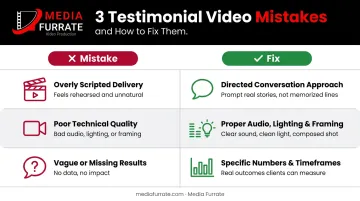
Three problems account for most failed testimonials:
Overly scripted delivery is the most common. Businesses try to control the message so tightly that the human element disappears entirely. The result is a video that feels like a press release read aloud — technically accurate, emotionally inert. A directed conversation nearly always outperforms a recited script.
Neglecting technical quality sends the wrong signal at exactly the wrong moment. A potential buyer watching a testimonial is already evaluating your business. Shaky footage, inconsistent lighting, and especially poor audio don't just distract — they raise doubts about whether the business takes quality seriously at all. How a video looks tells the viewer something about how you work.
Vague or missing results leave the story unfinished. A testimonial that ends with general satisfaction ("we were really happy with the outcome") provides no real evidence for the viewer. There's no conclusion to the arc, no specific claim they can weigh.
Coaching subjects ahead of time to recall concrete outcomes — numbers, timeframes, specific changes — is what turns a pleasant video into a persuasive one. Avoid all three of these pitfalls and you've already cleared the bar most testimonial videos don't.
Frequently Asked Questions
What is a video testimonial?
A video testimonial is short-form video content in which a real customer shares their firsthand experience with a product or service in their own words. Unlike written reviews, it delivers emotional resonance, facial expression, and vocal tone — making the endorsement feel far more personal and credible.
How long should a testimonial video be?
Most testimonial videos perform best between 60 seconds and 3 minutes. That range is long enough to follow the problem-solution-result arc but short enough to hold viewer attention through to the end.
Should a testimonial video be scripted or unscripted?
Unscripted is almost always better. Scripted responses sound coached, flatten emotional delivery, and make viewers skeptical. The subject should be guided by prepared questions, not rehearsed lines — the goal is authentic recall, not performance.
What makes a testimonial video credible?
Three things: a real, identifiable person speaking naturally; specific, measurable results rather than vague praise; and consistent technical quality — clear audio, good lighting, and professional framing throughout.
Where should you use testimonial videos?
The highest-impact placements are website landing pages, product and service pages, social media channels, email campaigns, and sales outreach. A single well-produced video can be repurposed across all of these with minimal additional effort.
Do you need a professional production company to make a good testimonial video?
For basic uses, some businesses manage in-house production. But professional direction, audio setup, lighting, and editing make a measurable difference in how credible and watchable the final video is. This matters most when the testimonial will appear on landing pages or in sales presentations, where production quality directly affects viewer trust.