Introduction
According to Wyzowl's research, 91% of businesses used video as a marketing tool in 2023 and 2024. Most organizations already know they need video — the confusion isn't about whether to invest, it's about what they're actually buying.
That gap shows up in nearly every first client conversation. Someone arrives with a concept and assumes production means "filming it" — not realizing that a full-service company also handles strategy, scripting, logistics, directing, editing, and platform-ready delivery as part of a single engagement.
This post breaks down what a full-service video production company actually does — from the first strategy call through final delivery — so you know exactly what's included, what questions to ask, and where your budget goes.
Key Takeaways
- A full-service video production company manages every phase: strategy, scripting, shooting, editing, and final delivery
- "Full-service" means you hand off an idea and receive a finished, broadcast-ready video — one team, one point of contact, no coordinating between vendors
- The three core phases are pre-production, production, and post-production
- Clients range from hospitals and industrial firms to marketing agencies — each getting a production tailored to their audience, not a templated package
- The real differentiator isn't equipment — it's strategic thinking, storytelling depth, and having someone manage the entire project from kickoff to final delivery
What Is a Full-Service Video Production Company?
A full-service video production company manages every phase of a project under one roof: concept development, scripting, filming, editing, and final delivery. You hand off an idea; you receive a finished video.
What It's Not
The term gets used loosely, so the distinction matters:
- A freelance videographer typically handles camera operation and basic editing. They can capture footage, but strategy and scripting usually aren't part of the engagement.
- An editing-only house works only in post-production — they need footage delivered to them before they begin.
- A creative agency that outsources production develops the concept but hands off the actual filming and editing to third parties, adding coordination layers and potential inconsistencies.
A genuine full-service company does all of it — and one team is responsible for the outcome from start to finish.
Why the Model Exists
Organizations in healthcare, industrial, and corporate sectors need more than someone who can operate a camera. They need a partner who understands their message, their audience, and the regulatory or technical complexity of their subject matter. When creative strategy and technical execution are split between separate parties, things fall through the cracks. The full-service model keeps both under the same roof — and the same vision.
Writing Is the Part Most Clients Miss
Scripting and message architecture are the foundation of any effective video. A company without strong writing capability can produce technically polished content that still fails to land — because no one asked what the video was actually supposed to say.
That question has to come first, before a camera is ever turned on.
At Media Furrate, writing isn't an add-on. Jason Furrate has served as the writer on 99% of over 10,000 productions since 1978. The process begins with a single question: What is your message, and what is the most effective way to deliver it to your audience?
Formats a Full-Service Company Should Cover
- Corporate brand and overview videos
- TV commercials and broadcast spots
- Customer testimonials
- Documentary-style interviews
- Training and safety orientation videos
- Healthcare and patient education content
- Social media spot ads
- Drone and aerial footage
- Live event coverage and streaming
What Does the Production Process Actually Look Like?
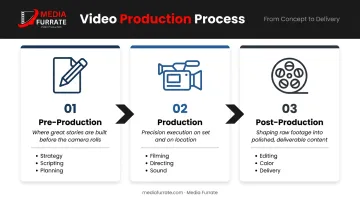
Every professional production follows three defined phases: pre-production, production, and post-production. Skip or compress any phase and the project suffers: budgets overrun, footage becomes unusable, and the final edit fails to deliver the message.
Pre-Production: Strategy, Scripting, and Planning
This is everything that happens before a camera turns on:
- Client discovery and audience research
- Concept development and message strategy
- Script writing or documentary-style interview framework design
- Location scouting and logistics planning
- Talent or subject coordination
- Shot list creation and scheduling
Pre-production determines whether production succeeds. ProductionHUB identifies concept development, detailed scripting, storyboarding, budgeting, scheduling, crew planning, and location selection as core pre-production components for corporate video — and they're right.
A well-structured script or interview framework means the footage captured during production is actually usable. Without it, you're hoping for the best on shoot day.
Media Furrate uses two distinct approaches depending on the project: fully scripted productions for commercials and structured content, and documentary-style organic interviews where Jason asks questions from just beside the camera while the subject speaks naturally. The average unscripted interview runs 12–20 minutes to capture all necessary material — the right fit gets sorted during the initial discovery conversation.
Production: Capturing the Footage
Shoot day involves far more than pointing a camera:
- Directing talent or interview subjects
- Camera operation and composition decisions
- Lighting design and setup
- Professional sound capture
- Location or studio logistics
- Real-time directing adjustments that shape the quality of usable footage
Crew composition matters here. Videomaker identifies common crew roles including producer, director, cinematographer, gaffer, sound manager, and script supervisor. A well-run production scales that list to match the actual scope of the project.
Media Furrate operates a mini-grip van with lighting equipment for on-location shoots and maintains studio access in Baton Rouge (with four background options: green, white, black, and muted gray), plus medium studios in Gonzales and Larose. For productions requiring aerial footage, an FAA-licensed drone pilot operates a 4K-equipped aircraft — a capability that integrates directly into the production engagement rather than requiring a separate vendor.
The FAA's Part 107 rule requires a Remote Pilot Certificate for all commercial drone operations. When a client's location falls in restricted airspace, waivers must be secured before operations begin. A production partner handles that process, not the client.
Post-Production: Editing, Graphics, and Finishing
The story gets assembled here:
- Footage review and selection
- Editing for narrative flow and pacing
- Color correction and grading
- Sound mixing and audio cleanup
- Music licensing
- Motion graphics and lower-third graphics
- Branded title cards and transitions
- Final formatting for intended platform (broadcast, web, social, internal)
Raw footage is raw material. The editorial decisions made in post-production determine whether a video communicates clearly and holds audience attention.
Platform delivery specs matter too. YouTube recommends MP4 with H.264 encoding, while LinkedIn specifies a 5 GB maximum file size and video durations between 3 seconds and 10 minutes for page uploads.
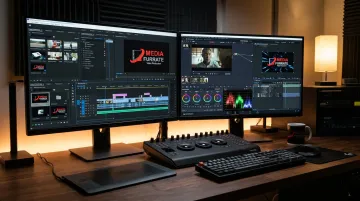
Media Furrate handles editing and motion graphics in-house, including custom animation for technically complex content — such as animated sequences showing how industrial systems work for engineering audiences.
Who Benefits Most From Full-Service Video Production?
Full-service production delivers the most value to specific types of organizations:
- Companies without in-house creative staff — no internal writer, editor, or director means you need a partner who can own the full process
- Organizations with complex or sensitive messages — healthcare procedures, industrial safety protocols, and regulated industries require writers and directors who understand how to translate technical content for non-expert audiences
- Businesses producing multiple formats — a company running TV spots, training videos, and social content simultaneously needs a production partner with breadth
- Industries where production quality reflects brand credibility — healthcare, industrial, and corporate sectors where a poorly produced video carries real reputational risk
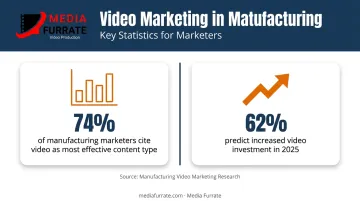
Content Marketing Institute's 2025 manufacturing research found that 74% of manufacturing marketers cited video as the most effective content type, and 62% predicted increased investment in video during 2025. These organizations need production partners who understand technical subject matter — not just equipment operators.
That demand extends beyond individual businesses — it's why agencies and PR firms seek the same kind of partner.
Why Agencies and PR Firms Partner With Full-Service Companies
Agencies frequently work with full-service production companies rather than managing production internally. They need an end-to-end production partner who can execute on both the creative and technical side without constant oversight.
Media Furrate works with local marketing firms and agencies across Louisiana and the Southeast — handling production from concept through final delivery so the agency can stay focused on strategy and client management.
The Baton Rouge Clinic commercial is one example: Jason Furrate served as producer, drone pilot, talent and location coordinator, and lighting director on a large-budget spot delivered through an agency relationship.
What's Typically Included in a Full-Service Video Package?
A genuine full-service company should provide all of the following:
| Service Area | What's Included |
|---|---|
| Strategy & Writing | Concept development, scripting or interview framework design |
| Planning | Project scheduling, location scouting, talent coordination |
| Production | On-location or studio filming, professional lighting and sound |
| Directing | Scripted and documentary/organic interview approaches |
| Aerial | FAA-licensed drone operation, 4K aerial footage |
| Post-Production | Editing, color grading, sound mixing, music licensing |
| Graphics | Motion graphics, lower thirds, branded title cards |
| Delivery | Platform-formatted files for broadcast, web, social, or internal use |
The Writing Component Is Worth Calling Out Separately
Wyzowl's 2026 survey found that 89% of consumers say video quality affects their trust in a brand. "Quality" isn't just lighting and resolution — it's whether the message is clear, the structure is logical, and the video says something worth watching.
A production company with deep writing experience invests in the effectiveness of the message, not just the aesthetics. That's a material difference in what you receive.
The LEAN Production Model: Full-Service Without Inflated Crews
Full-service doesn't require massive crews and bloated budgets. A well-run production company uses efficient crew structures and strong pre-production planning to control costs without sacrificing quality.
That's the philosophy behind Media Furrate's LEAN production model: keep crews as small as possible while maintaining the full scope of the project. More people and more steps mean more chances for something to go wrong — and higher costs.
For standard productions, a tight experienced team outperforms a large crew with coordination overhead. When a project genuinely requires additional crew, they scale up accordingly.
What's Not Typically Included
Most full-service production packages stop at delivery. Services that fall outside the production relationship generally include:
- Paid media distribution and ad buying
- Social media channel management or scheduling
- Content strategy beyond the video itself
- Video hosting or streaming platform management
If a vendor offers all of these bundled together, clarify whether video production is genuinely their primary focus or a smaller part of a larger digital marketing package.
How to Choose the Right Full-Service Video Production Partner
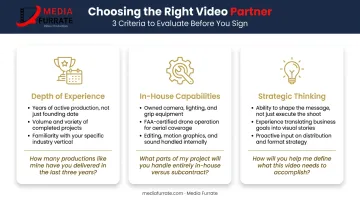
Three criteria matter most:
Depth of experience — Look at years in business, volume of completed productions, and format variety. A company with hundreds of projects across multiple industries has solved problems a newer operation simply hasn't faced yet.
In-house capabilities — Writing, directing, editing, motion graphics, drone, and studio access should all be available without subcontracting. Every external handoff introduces a gap in accountability.
Strategic thinking — Do they ask about your audience and message before the shoot date? A partner who leads with strategy delivers work that performs. One who leads with equipment delivers footage.
Review Their Portfolio Carefully
Look for diversity of formats and industries. A company that has only produced one type of content — or served only one sector — may not have the flexibility your project requires. For technically complex subject matter like healthcare or industrial safety, look for demonstrated experience in that specific context.
Communication and Process Transparency
Process transparency is what makes the day-to-day partnership functional. The best production partners:
- Ask substantive questions during discovery
- Provide clear project timelines
- Involve clients at pre-production, production, and post-production checkpoints
- Assign experienced senior producers to every project rather than delegating to junior staff
Media Furrate keeps its team lean for exactly this reason — every project involves direct participation from experienced producers and directors, not a handoff down the chain. With a four-person core team and over 45 years of production experience, clients work directly with the people doing the work.
Frequently Asked Questions
What does full-service video production mean?
Full-service video production means one company manages everything — concept, scripting, filming, editing, and final delivery. You bring an idea; they handle the rest without requiring you to coordinate separate writers, editors, or production crews.
How much does it cost to hire a video production company?
Costs vary based on scope, crew size, production days, and post-production complexity. Industry data generally puts video production agency rates in the $100–$150 per hour range, though most full-service companies quote on a per-project basis after an initial discovery conversation.
How much should a 3-minute video cost?
A professionally produced 3-minute video typically runs anywhere from $3,000 to $15,000 or more, depending on scripting, shoot days, location vs. studio, and motion graphics. Ask for an itemized scope rather than a single number — what's included matters as much as the price.
What is the difference between a videographer and a video production company?
A videographer typically handles camera operation and basic editing. A full-service production company adds strategic planning, scripting, directing, comprehensive post-production, and platform-formatted delivery — the scope and depth of involvement is far broader.
How long does video production take from start to finish?
Timelines vary by project complexity. A typical corporate or marketing video moves through pre-production, shoot day(s), and post-production over 4–8 weeks. Strong pre-production planning is the single biggest factor in keeping timelines on track.
What types of videos does a full-service production company make?
Common formats include corporate brand videos, TV commercials, customer testimonials, training and safety orientation videos, documentary-style interviews, healthcare and patient education content, social media spot ads, drone and aerial footage, and event coverage.