Here's the context that makes that hesitation costly: according to Wyzowl's 2026 report, 91% of businesses now use video as a marketing tool, and 83% of video marketers say it directly increased sales. Your competitors are already using it for pipeline, awareness, and customer trust.
This guide covers everything business owners, marketers, and brand communicators need to know — what corporate video production actually is, which formats serve which goals, how the production process works, what it costs, and how to find the right production partner.
Key Takeaways
- 91% of businesses use video as a marketing tool — it's no longer optional
- Corporate video production covers the full process: strategy, scripting, filming, and editing — every phase shapes the final result
- Match your video format to your goal: brand videos build awareness, testimonials close deals, training videos standardize information
- Costs range from $3,000 to $50,000+ depending on scope — cost per minute is a poor benchmark
- A strong production partner handles strategy and scripting, not just the camera work — that's where most ROI is won or lost
What Is Corporate Video Production?
Corporate video production is the full process of planning, scripting, filming, and editing video content created to serve a specific business goal. That goal might be generating leads, training employees, building brand awareness, or communicating with investors. What distinguishes it from consumer entertainment or social media content is intentionality: every creative decision traces back to a business objective.
Videography vs. Video Production
These terms get used interchangeably, but they describe different scopes of work.
Here's how the two differ in practice:
- Videography: Captures footage on the day — camera operation, recording, and basic on-site decisions
- Video production: Manages the full process — strategy, scripting, location scouting, the shoot, editing, color correction, motion graphics, and final delivery
When hiring, this distinction matters. A videographer captures what's in front of them. A video production company shapes what ends up on screen from concept through completion.
Why Production Quality Affects Business Outcomes
Poor quality isn't just an aesthetic problem — 89% of consumers say video quality impacts their trust in a brand. A shaky, poorly lit video signals low investment in your own brand, which audiences read as low credibility.
Quality alone doesn't guarantee results, though. A beautifully shot video with the wrong message still underperforms. The goal is strategic quality — production values that match your brand's positioning, combined with a message that actually resonates with your audience.
Types of Corporate Videos and When to Use Each
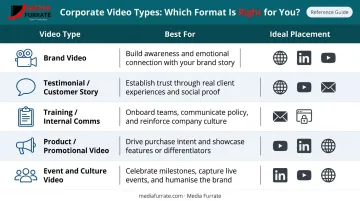
Different business goals call for different video formats. Using the wrong format wastes budget and misses the audience. Here's a practical breakdown:
| Video Type | Best For | Ideal Placement |
|---|---|---|
| Brand Video | Awareness, mission, emotional connection | Homepage, social media, investor decks |
| Testimonial/Customer Story | Bottom-funnel trust, purchase decisions | Sales pages, email, case study hubs |
| Training/Internal Comms | Onboarding, safety, policy standardization | Internal platforms, LMS, HR portals |
| Product/Promotional Video | Launches, campaigns, specific offers | Paid ads, email, social media |
| Event and Culture Video | Recruiting, brand humanization, event reach | Careers pages, LinkedIn, social |
Brand Videos
These communicate who you are — your mission, values, and personality. They work best at the top of the marketing funnel, where the goal is emotional connection rather than immediate conversion. Website homepages, social media profiles, and pitch presentations are common placements for brand videos.
Testimonial and Customer Story Videos
Real customer voices do something scripted promotion cannot: they create social proof. Wyzowl's testimonial research found that 77% of people who watched a brand testimonial video said it played a part in convincing them to buy, and two out of three said they were more likely to buy after seeing a testimonial from someone like them.
The key is authenticity. Rehearsed, over-coached testimonials lose the credibility that makes them valuable. Documentary-style interviews where subjects speak naturally in their own words consistently outperform scripted reads. At Media Furrate, for example, the interview process involves conversational questioning where the subject never needs to memorize a line, producing responses that feel genuine because they are.
Training and Internal Communication Videos
These videos standardize information across departments and locations — useful for safety orientations, onboarding, compliance training, and policy updates. Industrial companies in particular rely heavily on this format; safety orientation videos are the most common production type Media Furrate creates for industrial clients, requiring close coordination with legal teams to ensure messaging accuracy.
Promotional, Event, and Culture Videos
- Promotional videos are campaign-specific, built around a product launch, seasonal offer, or service announcement, and are designed for paid channels, email, and social media.
- Culture and recruitment videos humanize the brand and support hiring goals. Video-enabled job postings consistently generate higher application rates than text-only listings.
- Event recap videos extend the life of moments that would otherwise stay in the room.
Choosing the Right Format
A simple framework: match the video to the goal.
| Goal | Best Video Type |
|---|---|
| Awareness | Brand or promotional videos |
| Trust-building | Testimonials and customer stories |
| Education or standardization | Training and explainer videos |
| Recruiting and retention | Culture and event videos |
The Corporate Video Production Process: From Concept to Final Cut
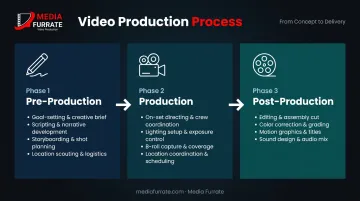
Pre-Production
Pre-production is where most video success is actually decided — before anyone picks up a camera.
This phase covers:
- Goal-setting — defining what the video needs to achieve and how success will be measured
- Audience definition — who specifically is watching, and what do they need to hear
- Scripting and messaging — translating the business objective into a clear, compelling narrative
- Storyboarding and shot planning — visualizing how the finished video will look
- Location scouting and casting — securing the environments and people the video requires
A production company that writes the script in-house brings a real strategic advantage here. When the person who understands your business goal is also crafting the narrative structure, the script serves the objective rather than just filling screen time.
Jason Furrate, founder of Media Furrate, has served as the writer on 99% of over 10,000 productions since 1978 — a depth of scripting experience that shapes every pre-production conversation.
Pre-production is also where the documentary-style approach proves its value. Rather than putting subjects through scripted rehearsals, a skilled interviewer can draw out authentic, credible responses through natural conversation — producing content that audiences trust precisely because it doesn't feel produced.
Production
The shoot day is where planning becomes footage. A well-prepared production team handles:
- Directing on-camera talent and managing performance
- Lighting and sound — the two technical elements viewers notice most when wrong
- Primary footage and b-roll capture
- Location coordination and schedule management
A lean crew keeps shoot days on schedule without the overhead that comes with larger productions. Media Furrate's LEAN production methodology is built on a straightforward principle: more people and steps mean more chances for complications and higher costs.
For industrial, real estate, and large-scale facility shoots, FAA-licensed drone operation adds cinematic aerial footage at a fraction of what helicopter shoots historically cost. High-resolution 4K drone footage captures scope and scale that ground-level cameras can't match, making it especially useful for showcasing facilities, properties, and outdoor operations.
Post-Production
Post-production transforms raw footage into a finished story. This phase includes:
- Editing — assembling footage into a coherent narrative
- Color correction — ensuring visual consistency and tonal accuracy across shots
- Motion graphics — titles, lower thirds, data visualizations, and branded animations
- Sound design and music — the audio layer that shapes emotional response
- Revision cycles — client feedback and refinement
Editors who were involved in pre-production produce more cohesive results. They understand what the footage was meant to communicate, which shapes every editorial decision. A turnkey production model — where writing, shooting, and editing happen under the same roof — preserves that creative continuity.
What Makes a Corporate Video Actually Effective?
Production quality is the baseline. The difference between a video that performs and one that gets forgotten comes down to message, story, and execution.
Message First
Effective corporate videos are built around one clear idea, communicated to a specific audience. Not a list of company features. Not a highlight reel of everything the organization does. One idea, one audience, delivered with focus.
Jason Furrate's 45 years of marketing research — including phone surveys, focus groups, and real-time audience testing — are grounded in one core principle: how the brain processes two-dimensional screen media shapes every scripting decision. What works in a conversation doesn't always translate on screen, and experienced writer-producers know exactly where that gap lives.
Emotional Storytelling Over Hard Selling
The brain processes narrative differently than it processes information. When viewers become absorbed in a story, they retain more and trust the message more. A well-structured customer story consistently outperforms a feature list — even when the underlying facts are identical.
Practical Best Practices
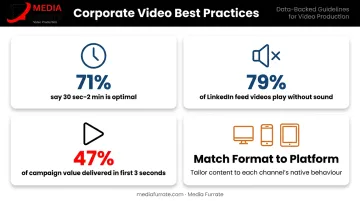
- Keep videos concise. 71% of people say 30 seconds to 2 minutes is optimal. Lemonlight recommends brand videos at 2-3 minutes, product demos at 60-90 seconds, testimonials at 1-2 minutes, and training videos at 5-10 minutes.
- Design for silent viewing. LinkedIn reports 79% of feed videos play without sound. Captions and text overlays aren't optional — they're essential.
- Hook early. Meta's internal data shows up to 47% of a video campaign's value is delivered in the first 3 seconds.
- Match format to platform. YouTube, LinkedIn, Instagram, and email each have different content expectations and viewer behaviors.
Distribution Strategy
Getting the production right is only half the equation. A well-produced video still underperforms on the wrong channel.
- Owned channels (website, email) — highest-intent audiences, ideal for brand and testimonial videos
- Paid channels (social ads, YouTube pre-roll) — reach new audiences with promotional and brand content
- Earned distribution (PR, organic shares, LinkedIn) — extends reach through credibility rather than spend
How Much Does Corporate Video Production Cost?
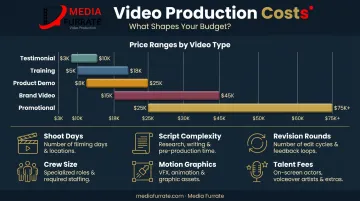
Costs vary widely based on scope, format, crew size, and post-production complexity. Here's a current benchmark by project type:
| Video Type | Typical Price Range |
|---|---|
| Testimonial / Case Study | $3,000 – $15,000 |
| Training / Internal Communications | $3,000 – $25,000 |
| Product Demo | $5,000 – $20,000 |
| Brand / Overview Video | $5,000 – $50,000+ |
| Promotional / Campaign Video | $8,000 – $75,000+ |
Source: Vidico Corporate Video Cost Guide 2026
Clutch's June 2026 pricing data shows most video production agencies charge $100–$149 per hour, with the average reviewed project costing around $42,000.
What Drives Cost Up or Down
- Number of shoot days and locations
- Script complexity and pre-production depth
- Crew size and equipment requirements
- Motion graphics and animation needs
- Number of revision rounds
- Talent fees (on-camera talent, voiceover)
A LEAN production methodology directly reduces costs by keeping crew sizes tight and eliminating unnecessary production steps. Media Furrate operates this way by design, which keeps budgets manageable without sacrificing quality.
The Cost-Per-Minute Problem
Those cost drivers explain why price per finished minute is a misleading way to budget. A 90-second product commercial often costs more than a 5-minute training video — the commercial demands tighter scripting, higher production design standards, and more polished post-production.
Evaluate cost relative to the video's business objective and expected return, not its runtime.
How to Choose the Right Corporate Video Production Partner
The right partner isn't just technically capable — they're strategically useful from day one.
Key Criteria to Evaluate
- Confirm whether they handle scripting and post-production, or only the camera work
- Review their portfolio across multiple video types — experience with one format doesn't transfer automatically
- Ask them to walk you through pre-production before a single shoot day is on the calendar
- Get pricing that accounts for post-production and revisions upfront — not after the fact
Why Scripting Expertise Matters as Much as Technical Skill
A production company that has only ever operated a camera will capture what's in front of it. A company with deep scripting experience shapes what gets in front of the camera in the first place.
Media Furrate's model illustrates this distinction. Jason Furrate has served as the writer on 99% of over 10,000 productions — a depth of scripting experience that shapes strategy before the camera ever rolls.
The company's turnkey approach covers everything from initial brief through final delivery, and the LEAN methodology keeps crew sizes lean and costs predictable without cutting corners on quality.
The Case for a Local or Regional Partner
For most small-to-mid-sized businesses, a local production company offers real advantages over large national agencies:
- Faster turnaround and scheduling flexibility
- In-person pre-production collaboration
- Familiarity with regional markets, locations, and industry context
For businesses in Baton Rouge and across the Southeastern United States, working with a local team that knows the Gulf South market — its industries, its visual landscape, its client communication norms — means less time explaining your industry context and more time building content that connects with your actual audience.
Frequently Asked Questions
What is corporate video production?
Corporate video production is the end-to-end process of creating video content for business purposes — from strategy and scripting through filming and post-production. The goal is always a specific business outcome: brand awareness, lead generation, employee training, or internal communication.
What are the 4 stages of video production?
The four stages are development (concept and goal-setting), pre-production (scripting, planning, location scouting), production (filming), and post-production (editing, graphics, and delivery). Development is often overlooked but determines the success of everything that follows.
How much does a corporate video cost per minute?
Cost per minute is a poor benchmark because complexity drives pricing more than length. A 90-second commercial can cost more than a 5-minute training video. Most corporate video projects run from $3,000 to $50,000+ depending on scope — so evaluate cost against your business objective, not the runtime.
How long does it take to produce a corporate video?
Simple testimonial or event videos typically take 1–2 weeks. Brand videos and scripted productions with full pre-production generally run 4–8 weeks from brief to delivery. Timeline varies based on script complexity, number of shoot days, and revision cycles.
What types of corporate videos are most effective for businesses?
Effectiveness depends on the goal. Testimonials and brand videos build trust and awareness. Training videos standardize performance across teams. Promotional videos support product launches and campaigns.
Should I hire a local video production company or a national agency?
For most small-to-mid-sized businesses, a local full-service team offers better responsiveness, in-person collaboration, and regional market knowledge. National agencies may offer scale, but often at higher cost and with less flexibility.