The paradox facing businesses in 2026 isn't whether to invest in video. That debate is settled. The real challenge is producing video that actually moves people to act rather than scroll past in under two seconds.
This guide walks business owners, marketers, and agencies through the full marketing video production process — from strategy and planning through distribution and measurement. More than a technical overview, it's a practical look at what separates videos that generate results from the ones that get ignored.
Key Takeaways
- Marketing video production covers four stages: pre-production, production, post-production, and distribution — and all four matter equally.
- The video format you choose should match your specific business goal, not just what's trending.
- Standing out means knowing your audience, defining your goal, and committing to authentic storytelling before you hit record.
- Businesses without in-house creative expertise typically see stronger ROI from a professional production partner than from DIY or freelance work.
Why Video Marketing Is Non-Negotiable in 2026
The business case for video isn't theoretical anymore. According to Wyzowl's 2026 Video Marketing Statistics report, 85% of consumers have been convinced to buy a product or service after watching a video — and 82% of marketers say video gives them good ROI.
The lead and sales data backs that up: 78% of marketers say video helped generate leads, and 83% say it directly increased sales.
That ROI is coming from more channels than ever. Video has expanded far beyond YouTube and broadcast television:
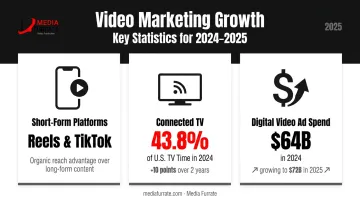
- Short-form platforms (Instagram Reels, TikTok) reward video content with organic reach that static posts rarely match
- Connected TV (CTV) is now a serious channel — streaming represented 43.8% of U.S. TV time in March 2025, a 10-point increase over two years
- Digital video ad spend grew 18% year-over-year in 2024 to $64 billion, with projections reaching $72 billion in 2025
For most businesses, video is no longer a "nice to have" line item — it's where audiences spend their time and where budgets follow. The rest of this guide covers how to produce video that actually performs across these channels.
Types of Marketing Videos That Drive Results in 2026
Not all video formats serve the same purpose. Choosing the wrong format for your goal is one of the most common and costly mistakes in marketing video production.
The Formats Worth Your Investment
- Explainer videos — ideal for products or services that require demonstration before a prospect will buy
- Documentary-style testimonials — build credibility and trust through real customer voices; testimonial video production jumped from 17% to 47% of companies between 2023 and 2026, according to industry tracking data
- Product and service demos — show outcomes, not just features; particularly effective for industrial and technical audiences
- Short-form social clips — 15–60 second content designed for Reels, TikTok, and LinkedIn feed
The strongest marketing videos often blend formats. A testimonial that opens with a problem-statement hook and closes with a product demo earns attention and drives action in a single piece.
Why Authenticity Is Outperforming Polish
The jump in testimonial video production — from 17% to 47% of companies in three years — reflects something viewers already knew: real people are more persuasive than polished brand messaging, no matter the production budget.
Media Furrate's documentary-style interview approach puts this into practice. Rather than scripting subjects, the producer positions himself beside the camera and asks questions conversationally — letting business owners and clients speak naturally. Interview sessions typically run 12–20 minutes, capturing genuine responses that audiences recognize as real. The result is content that holds attention because it was never performed.
Industry Matters More Than Most Brands Realize
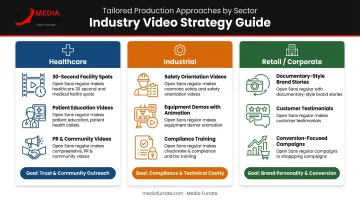
A healthcare organization and an industrial supplier both need video — but the tone, format, and trust signals they need are entirely different.
| Industry | Recommended Format | Primary Goal |
|---|---|---|
| Healthcare | 30-sec facility spots, patient education, PR videos | Trust, community outreach |
| Industrial | Safety orientation, equipment demos with animation | Compliance, technical clarity |
| Retail/Corporate | Documentary-style brand stories, testimonials | Brand personality, conversion |
The 4 Stages of Marketing Video Production
Pre-Production: Strategy and Planning
Pre-production is where great videos are built — and where most underperforming videos went wrong long before the camera turned on.
This phase covers:
- Goal definition — is this video for awareness, lead generation, conversion, or education?
- Audience identification — who is watching, and what do they need to see to take the next step?
- Budget and timeline — setting realistic parameters before creative decisions are made
- Format and distribution channel decisions — vertical for Reels, widescreen for YouTube, longer-form for landing pages
Pre-production should produce a creative brief, script or story outline, storyboard or shot list, location scouting notes, and talent decisions. Skipping this phase — or rushing it — is the most reliable way to produce a video that looks fine but doesn't perform.
At Media Furrate, every production starts with a conversation, not a camera. The first questions are always: What is your message, and what is the most effective way to deliver it to the right audience? Jason Furrate has written scripts for 99% of more than 10,000 productions since 1978, and the foundation of that work has always been listening before scripting.
Production: Capturing the Story
The production phase is when filming takes place. A well-run shoot balances three things: capturing what's needed, staying on schedule, and controlling costs.
Core considerations during production:
- Crew roles — director, producer, cinematographer, and sound coverage
- Platform framing — shooting for multiple ratios (vertical for social, widescreen for broadcast/YouTube) should be planned in pre-production, not improvised on set
- Efficiency — Media Furrate's LEAN production model keeps crew size minimal by default, reducing both cost and the chance of logistical breakdowns; the team scales up only when the production genuinely requires it
FAA-licensed drone cinematography deserves specific mention here. Aerial footage — facility overviews, event coverage, location-based business marketing — delivers visual impact that ground-level cameras can't match. For clients like the Baton Rouge Clinic, PALA, and property owners across Louisiana and Texas, drone footage has been integrated directly into marketing campaigns. The cost is a fraction of traditional helicopter production.
Post-Production: Editing and Polishing
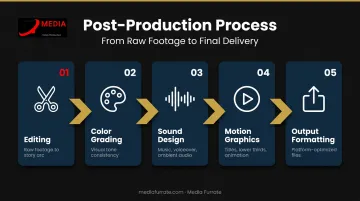
Post-production is where raw footage gets shaped into something an audience will actually watch through to the end. This phase covers:
- Editing — cutting raw footage to the right pace and story arc
- Color grading — creating visual consistency and tone
- Sound design and mixing — music selection, voiceover, ambient audio
- Motion graphics — title cards, lower thirds, animated explainer elements
- Output formatting — exporting final files optimized for each platform
Pacing is where most amateur edits fall apart. A video that holds audience attention through to the call to action requires deliberate rhythm — not just trimming the boring parts. For complex industrial projects, Media Furrate has also produced custom animation, such as the Safe Zone welding enclosure videos that help engineers visualize how offshore systems work.
Distribution: Getting Your Video Seen
A polished final cut means nothing if it never reaches the right audience. Distribution strategy should be decided before production wraps — not after.
Platform matching by goal:
- YouTube — long-form explainers, product demos, educational content
- Instagram Reels / TikTok — short-form brand content, social proof clips
- LinkedIn — B2B video, company overviews, thought leadership; 81% of B2B teams use LinkedIn as their primary video sharing platform
- Website landing pages — conversion-focused videos where watch time directly correlates with lead capture
What to track (not vanity metrics):
- Watch time and drop-off points
- Click-through rates on calls to action
- Lead form completions or purchases attributable to video
- View completion rates by platform
Likes and view counts feel good. Click-throughs and conversions justify the budget at your next review.
Best Practices for Marketing Videos That Stand Out in 2026
Lead With the Viewer's Problem, Not Your Brand's Features
The most common reason a marketing video gets scrolled past: it opens with the brand, not the audience. The first question a viewer asks is what's in this for me? If the video doesn't answer that within the first few seconds, you've already lost them.
Effective videos are built around the viewer's situation. What problem are they trying to solve? What outcome do they want? The brand enters the story as the solution, not the headline.
Make the First 3 Seconds Do the Heavy Lifting
Meta's own research found that up to 47% of a video campaign's total value is delivered in the first 3 seconds — and up to 74% in the first 10 seconds. On platforms where skipping is one swipe away, your hook isn't an introduction. It's a filter.
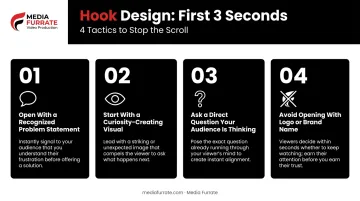
Practical hook design:
- Open with a problem statement the viewer recognizes immediately ("If your safety orientation videos aren't getting through to new employees...")
- Start with a visual that creates curiosity or contrast before any narration
- Ask a direct question your audience is actively thinking about
- Avoid opening with your logo, your company name, or "Hi, we're [Brand]"
Define One Measurable Goal Before You Script Anything
A video without a defined success metric can't be optimized, and it can't be justified when someone asks what it produced. Before scripting begins, answer one question: What specific action should a viewer take after watching this?
That answer shapes everything: the script, the call to action, the platform, and the length. It also clarifies which metrics actually matter:
- Leads and conversions — the outcomes your video should drive
- Watch time and completion rate — signals of whether the message landed
- Raw view counts — a vanity metric that tells you almost nothing on its own
Keep It as Short as the Message Requires
Length should follow the message, not a template. General benchmarks by platform and placement:
- 15–30 seconds: Paid social ads (Instagram, Facebook, YouTube pre-roll)
- 30–90 seconds: Organic social content and brand awareness
- 2–5 minutes: Landing pages, product/service explanations, case studies
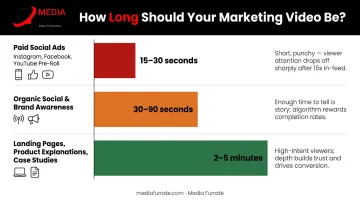
Brevity is a craft. A tight 60-second video can carry a complete message — problem, solution, credibility, call to action — if the script is built around one goal from the start. If a video feels long, the issue is usually an undefined objective, not the runtime.
How Much Does Marketing Video Production Cost in 2026?
Production costs vary significantly based on scope, and any specific numbers should be treated as directional rather than fixed. The key cost drivers are:
- Crew size and experience — more specialized roles mean higher day rates
- Location complexity — controlled studio environments cost less than multi-location shoots
- Talent — real customers and employees vs. professional actors carry different cost profiles
- Post-production needs — custom animation and complex motion graphics add time and cost
- Number of deliverables — one final cut vs. five platform-optimized versions
The LEAN production approach keeps crews small and experienced — no 15-person setup for a two-person interview. A team with 10,000+ productions behind it knows how to capture what's needed efficiently, without the logistical drag of an oversized crew.
The more useful question is: what does this video need to achieve, and what's the return on that investment? A well-crafted video that generates qualified leads pays for itself. Budget matters, but it's rarely the determining factor in whether a video works.
When to Work With a Professional Video Production Company
Three Signs You Need a Production Partner
- You lack in-house scriptwriting and creative strategy expertise — and the video needs to perform a specific business function
- The project requires specialized equipment or environments: aerial footage, industrial facilities, clinical healthcare settings
- Video quality directly affects brand trust — Wyzowl found that 89% of consumers say video quality impacts their trust in a brand
What a Turnkey Production Company Delivers
A professional firm takes the project from strategy through final delivery. The client's job is to communicate the goal and the message. The production team handles everything else.
That scope is meaningfully different from hiring a freelance videographer, who typically handles camera work and basic editing — without scriptwriting, audience research, or marketing-informed creative direction.
A full-service production partner covers:
- Strategy and concept development
- Scriptwriting and messaging
- Casting and location coordination
- Filming, lighting, and direction
- Editing, motion graphics, and final delivery
In-House vs. Outsourced: The Evidence-Based Answer
Wyzowl's 2026 data shows 59% of businesses create video in-house, 32% use a hybrid model, and 10% rely exclusively on external vendors. Wistia found that companies producing more than 250 videos annually are 41% more likely to use in-house teams.
In-house works when volume is high and the stakes per video are lower. Professional partners make sense when a video must achieve a specific business outcome, represent the brand at a high level, or require expertise the internal team doesn't have.
For most businesses producing video campaigns — not recurring social content — outsourcing to an experienced production company produces stronger creative outcomes with less internal strain.
Frequently Asked Questions
What are the 4 stages of video production?
The four stages are pre-production (planning, scripting, storyboarding), production (filming), post-production (editing, color grading, sound design, motion graphics), and distribution (publishing, promoting, and measuring performance). Each stage depends on the one before it — skipping pre-production almost always creates problems in production.
How much does marketing video production cost?
Costs range from under $5,000 for simple social content to $25,000 or more for high-end campaigns with multiple locations and advanced post-production. Align your budget with the specific business goal the video needs to achieve, not just the lowest price point.
What type of marketing video works best for small businesses?
Small businesses get the best results from customer testimonials, documentary-style brand stories, and explainer videos. These formats build trust without requiring large budgets — and authentic storytelling consistently outperforms polished advertising for audience connection.
How long should a marketing video be?
Most marketing videos perform best at 30 seconds to 2 minutes. Paid social ads work best at 15–30 seconds, while website landing pages and detailed product explanations can justify longer formats. Length should be determined by message complexity and audience context, not habit.
Should I hire a professional video production company or do it in-house?
In-house works well for high-volume, lower-stakes social content. A professional production partner is the stronger choice when a video must achieve a specific business goal or represent your brand at a high level. It's also the right call when the project requires scripting, cinematography, or creative strategy your team doesn't have.
What makes a marketing video stand out from the competition in 2026?
Standout videos share a few common traits:
- Hook the viewer in the first 3 seconds
- Address the viewer's problem before the brand's features
- Use authentic storytelling over polished promotion
- Close with a single, clear call to action
All of this works best when a defined success metric is established before production begins.