According to Wyzowl's 2026 research, 89% of consumers say video quality directly impacts their trust in a brand. That trust judgment happens fast, and editing is what determines whether your video looks credible or amateur, whether the message lands or gets skipped.
The problem: most business owners don't know what professional video editing actually includes, what separates capable post-production from someone who just cuts clips together, or what any of it should cost.
This guide covers all of it — what editing services include, best practices that make business videos perform, how to evaluate a partner, and realistic pricing benchmarks.
Key Takeaways
- Professional editing shapes narrative, pacing, audio, and brand consistency across every frame
- Front-load your hook: viewers who don't get value in the first 10 seconds drop off fast
- Audio quality affects credibility as much as visuals — poor sound loses audiences even when the footage is strong
- Pricing spans flat project rates, monthly subscriptions (~$849–$2,749/mo), and full-service packages ($5,000–$40,000+)
- The strongest editorial outcomes come from partners involved before the camera rolls, not after
What Business Video Editing Services Actually Include
Many businesses think editing means trimming clips and adding music. Professional editing covers a much longer checklist.
The Technical Deliverables
A polished business video typically involves:
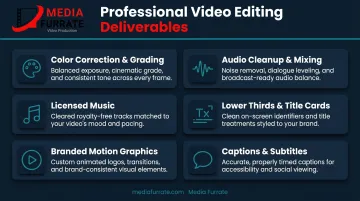
- Color correction and grading: balancing exposure and color consistency across shots, then applying a grade that matches brand tone
- Audio cleanup and mixing: noise reduction, level balancing, dialogue clarity, and music integration
- Licensed music: sourcing and clearing background tracks that fit the video's tone without copyright risk
- Lower thirds and title cards: on-screen text identifying speakers, locations, or key points
- Branded graphics and motion elements: intros, outros, logo treatments, and animated data callouts
- Captions and subtitle tracks: essential for accessibility and for the large percentage of viewers watching without sound
Motion graphics serve more than aesthetics. In business video, animated statistics, process diagrams, and branded callouts reinforce key messages and hold attention in sections where static talking-head footage would otherwise cause drop-off. That distinction points to something more fundamental about how good business editors approach their work.
Message-First vs. Aesthetics-First Editing
There's a real difference between editing that makes footage look polished and editing that makes a message land.
Aesthetics-first editing focuses on visual appeal : smooth transitions, color treatment, a nice soundtrack. Message-first editing starts by asking: Who is watching this? What do they need to understand? What should they do after watching?
The most experienced business editors have those questions answered before they open a single clip. At Media Furrate, that starts well before post-production. Jason Furrate has written 99% of the company's 10,000+ productions since 1978, so the edit begins with a clear message already defined — not one discovered along the way.
Revision Workflow
A professional editing engagement includes structured revision cycles, not open-ended changes. Typical workflow:
- Editor delivers a first cut based on agreed brief
- Client provides consolidated feedback within a defined review window
- Editor delivers a revised cut addressing those notes
- Final approval and file delivery
Clear creative briefs at the start prevent scope creep during revisions and keep projects on schedule.
Strategic Editing vs. Post-Production Assembly
Post-production assembly is the mechanical process of arranging clips in sequence. Strategic editing goes further — it involves editorial judgment: deciding what to cut, what to emphasize, how to pace the narrative, and where the emotional or logical turning points need to fall.
The difference shows up most clearly in corporate interview content. When a producer spends 15–20 minutes capturing unscripted, natural conversation from a subject, the raw footage contains a lot of material — some excellent, some redundant, some unusable. The editor's job isn't to include everything; it's to find the moments that build a compelling story and sequence them in a way that feels natural, not constructed.
This is why having the writer and editor involved from the scripting stage matters. When the same person who wrote the production plan is also shaping the edit, there are no narrative gaps to fill in post. The footage was gathered with the finish line already in mind.
That integration is exactly what separates strategic editing from assembly work in practice. Jason Furrate of Media Furrate started his career as an editor in 1978 — a foundation he credits as "the best teacher in production." Having written 99% of his own scripts across 10,000+ productions, he approaches every shoot with the edit already in mind: knowing what's needed before the camera rolls means fewer reshoots and fewer problems that can't be fixed after the fact.
Key Video Editing Best Practices for Business Content
Front-Load Your Value
Wistia's engagement data is consistent: a large drop in the first 10–15 seconds signals the opening isn't delivering fast enough. In one documented case, re-editing an intro to get to the point within 10 seconds increased overall engagement by 5 percentage points and cut initial viewership loss in half.
For business video, this means the hook — the key message, the strongest visual, the most compelling claim — belongs at the front. Not after a 20-second brand intro.
Completion rates also tell the story clearly. Vidyard's 2024 benchmark report found:
- 65% of viewers watch videos under 1 minute to completion
- 20% finish videos over 20 minutes
That's not an argument against long-form content. It's an argument for tight editing regardless of format.
The 80/20 Principle in Editing
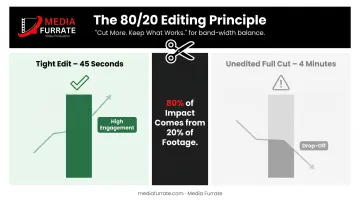
Professional editors know that a small fraction of footage carries most of a video's impact — the one soundbite that lands, the visual that makes the point instantly, the 10-second demonstration that replaces two minutes of explanation.
The discipline is cutting everything else, even when significant filming time went into capturing it. A 45-second testimonial built around one genuinely compelling moment typically outperforms a 4-minute version that includes everything the subject said. That kind of restraint is a learned craft skill.
Audio Is Non-Negotiable
Poor audio doesn't just sound bad — it makes the speaker seem less credible. Studies consistently show that audio quality directly affects how audiences perceive the trustworthiness of the information and the person delivering it.
Professional audio editing includes:
- Noise reduction (HVAC hum, background noise, wind)
- Dialogue level balancing across multiple speakers
- Music mixing that supports without overwhelming speech
- Consistency checks so audio levels don't jump between cuts
Visuals that look slightly off can still hold an audience. Audio that sounds amateurish loses viewers — and worse, undermines the credibility the video was meant to build.
Brand Consistency Across Video Libraries
Individual videos can look acceptable in isolation while creating a fragmented impression across a company's full content library.
When lower thirds use different fonts, intro sequences don't match, or music tone varies wildly between pieces, the cumulative effect erodes brand credibility over time.
Professional editing maintains consistency through:
- Locked brand templates for lower thirds, title cards, and motion graphics
- Defined color grade profiles per client
- Consistent intro/outro sequences across all productions
- Music tone guidelines that align with brand personality
The 2D Screen Problem
One of the less-discussed editing challenges is the physical constraint of the medium: a flat screen can't replicate the spatial depth, ambient sound, or peripheral engagement of being physically present in an environment. Editors compensate through pacing, close-up selection, cutaway sequencing, and strategic use of music — creating the sense of engagement that would happen naturally in person.
Jason Furrate calls this a core editorial concern: understanding "how the brain reacts to the two-dimensional restrictions of watching something on a screen" and using editorial tools to work around those limitations.
Types of Business Videos That Require Professional Editing
Different video types aren't just different lengths — they require fundamentally different editorial approaches.
| Video Type | Editorial Priority |
|---|---|
| Corporate brand film | Narrative arc, emotional pacing, brand tone |
| Product demonstration | Clarity of process, visual sequencing, concision |
| Customer testimonial | Authenticity, strongest moments from raw interview footage |
| Healthcare / patient education | Accuracy, clarity, compliance-appropriate pacing |
| Industrial safety / training | Procedural completeness, legal review integration |
| Event recap | Energy and atmosphere, highlight moment selection |
| Social media ad | Immediate hook, compressed messaging, caption dependency |
Long-form formats — brand films, case studies, documentary-style interviews — need narrative architecture and an emotional arc that builds over time. A 30-second social ad, by contrast, needs the hook in the first three seconds and the full message compressed into under a minute.
Documentary-style interview editing is a particular skill. When a subject speaks naturally for 15–20 minutes, the editor must extract the clearest, most authentic moments and build a coherent story from them, with no script to fall back on.
Media Furrate's approach to this format involves the producer making eye contact just off-camera to encourage natural conversation — capturing the authentic moments that scripted productions rarely achieve.
Multi-Platform Editing
The same core footage rarely works as-is across all distribution channels. Wistia reports that 76% of video teams resize content for different platforms — and that resizing involves more than aspect ratio changes.
Platform-specific editing considerations:
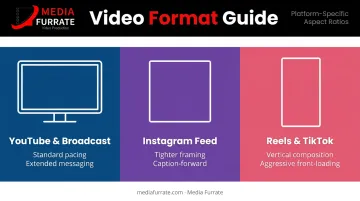
- 16:9 for broadcast and YouTube — standard pacing, extended messaging
- 1:1 for Instagram feed — tighter framing, caption-forward
- 9:16 for Reels and TikTok — vertical composition, aggressive front-loading
Each format also has distinct viewing behaviors that affect how quickly you need to establish value and how much text/caption support the edit needs.
How to Choose the Right Business Video Editing Partner
Portfolio Evaluation
A strong demo reel demonstrates range. But the more important question is: does this editor or company have experience in your content type?
Event brand content requires different judgment than healthcare communication or industrial safety training. Review portfolios specifically for:
- Industry familiarity (healthcare, industrial, corporate)
- Comfort with interview-heavy content vs. scripted production
- Evidence of branded consistency across multiple pieces for the same client
- Motion graphics and caption quality
Process Questions That Matter
Before hiring, ask:
- Do you start by understanding our audience and business goal, or do you wait for footage?
- Who is my point of contact throughout the project?
- What does your revision policy include?
- Have you worked on content in our industry before?
The best partners ask you questions first. If an editing service jumps straight to deliverables and timelines without asking about your audience, the message, or the intended outcome, that's a signal.
Full-Service vs. Editing-Only
An editing-only service accepts footage after the shoot. That means the story structure, pacing potential, and narrative gaps are already locked in. If the shoot didn't capture what was needed, editorial fixes in post have hard limits — gaps in coverage stay gaps.
A full-service production company, like Media Furrate — with over 45 years of experience spanning writing, production, and editing — builds the editorial strategy before the camera rolls. The writer knows what the edit will need. The shoot is planned around the finish line. This integration typically produces stronger results and avoids expensive reshoots caused by gaps discovered in post.
Regional Presence for Specialized Industries
For healthcare, industrial, and energy clients, on-site context matters. An editor who has never been inside a petrochemical facility or a hospital setting lacks the contextual understanding to make strong editorial judgments about what footage communicates what.
Media Furrate's presence across Louisiana and Texas — with facility access spanning Baton Rouge, Lafayette, New Orleans, Gonzales, and Larose — means the team can be on-site when the project demands it. That proximity is particularly relevant for:
- Safety orientation videos, where legal accuracy shapes every edit decision
- Healthcare content, where facility-specific context drives the narrative
- Industrial overviews, where the environment itself is the story
Understanding Business Video Editing Costs
What Drives Cost
Editing price varies based on:
- Video length and complexity — a 90-second social ad and a 20-minute training video are fundamentally different projects
- Motion graphics volume — animated statistics, branded templates, and custom graphics add time
- Revision rounds — more rounds = more labor = higher cost
- Music and stock licensing — cleared licensed tracks add to project cost
- Turnaround speed — rush timelines typically carry a premium
Pricing Models and Current Ranges
| Model | Approximate Range | Notes |
|---|---|---|
| Hourly (editing only) | $45–$150+/hour | Mid-level to senior editor rates |
| Per-project (editing only) | $400–$2,500 | 2–5 minute corporate content |
| Monthly subscription | $849–$2,749/month | High-volume social content |
| Full-service production | $5,000–$40,000+ | Writing, shooting, and editing bundled |
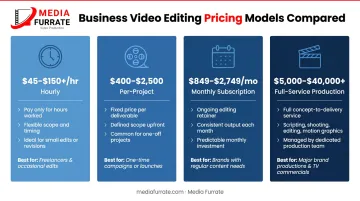
Ranges sourced from Krock.io's 2026 pricing guide and Capture Video & Marketing's 2026 pricing data. Actual pricing varies by scope, market, and service model.
These ranges make one thing clear: price alone isn't a reliable guide. A video with a specific business purpose — a healthcare explainer, an industrial safety orientation, a TV spot — needs editing that serves the message. A poorly structured edit that obscures your point or triggers a reshoot will cost more than the savings on the original quote.
Common Mistakes Businesses Make with Video Editing
Underestimating Post-Production Time
Most businesses allocate the majority of their budget to the shoot day and treat editing as a minor final step. In professional production, post-production often requires as much time as — or more than — the shoot itself.
For a single corporate project, expect:
- Filming: 1–3 days on set
- Editing and revisions: 8–20 additional business days
- Full timeline: 3–8 weeks from discovery to final delivery
Plan your budget and deadlines around the full cycle, not just the shoot day.
Treating Platform Formats as Interchangeable
Each platform has distinct viewing behavior — and the same cut rarely works across all of them. A horizontal broadcast edit dropped into vertical mobile formats loses framing, key visuals, and readability. These aren't cosmetic differences; they determine whether the message reaches the viewer at all.
Common format mismatches include:
- Uploading a 16:9 broadcast cut directly to Instagram Reels or TikTok
- Applying documentary pacing to a 30-second ad
- Using desktop-sized text overlays on mobile-first placements
Neglecting Audio and Captions
Three audio and caption oversights show up repeatedly in corporate video — and each one is avoidable:
- Skipping audio cleanup: Inconsistent levels, background noise, or music that competes with dialogue erodes brand credibility the video was meant to build.
- Omitting captions: Meta's internal testing found captioned video ads increased view time by an average of 12%. Captions are also required under WCAG 2.2 accessibility guidelines for prerecorded synchronized media — skipping them creates a compliance gap for organizations subject to accessibility standards.
- Using unlicensed music: This can trigger content takedowns or legal exposure. Reputable editing services handle music licensing as part of the deliverable.
Frequently Asked Questions
How much does it cost to professionally edit a video?
Business video editing typically runs $400–$2,500 per project for editing-only work, $849–$2,749/month for subscription models, or $5,000–$40,000+ when bundled with full production. Final cost depends on video length, motion graphics complexity, revision rounds, and whether scripting and filming are included.
What is the 80/20 rule in video editing?
The 80/20 principle holds that most of a video's impact comes from a fraction of its content — the sharpest soundbites, clearest visuals, and most direct messaging. Professional editors apply this by cutting weaker footage without hesitation, even material that was costly to capture. A tight 45-second piece built around the best moments typically outperforms a longer version that includes everything.
What is the 3-2-1 rule in video editing?
The 3-2-1 rule is a file management and backup standard used in professional video workflows. It means keeping 3 copies of your project files, stored on 2 different media types, with 1 copy stored offsite. For business video clients, this applies to protecting raw footage, project files, and final deliverables from loss — not a structural editing formula.
What types of business videos require professional editing?
Most business formats benefit from professional editing: brand films, customer testimonials, healthcare and patient education videos, industrial safety training, product demonstrations, and social media ads. Each has different structural demands — safety training requires procedural accuracy, while social ads need immediate hooks and compressed messaging.
How do I prepare my footage before sending it to a video editor?
Organize files by scene with clear naming conventions and flag your preferred takes. Include a brief that covers your intended audience, key message, and desired viewer action. Supply brand assets upfront — vector logos, approved fonts, music guidelines, and any existing templates.
What is the difference between a video editing service and a full-service video production company?
An editing-only service works with footage that has already been filmed — meaning story structure, pacing potential, and any narrative gaps are locked in before they arrive. A full-service production company like Media Furrate handles scripting, filming, and editing as an integrated process, building the editorial strategy before the camera rolls. This typically produces stronger narrative alignment and eliminates the post-production surprises that come from footage shot without an editorial plan.