Most healthcare organizations recognize this shift but struggle to act on it. They post a few videos, see modest results, and conclude that video "doesn't really work" for them. The problem isn't video — it's the absence of strategy. The right format, production approach, and distribution channel make the difference between content that converts patients and content that sits unwatched.
This guide covers the types of healthcare videos that actually perform, what to do before you film, how to produce and deploy content step by step, and the practices that separate high-performing healthcare video programs from those that never gain traction.
Key Takeaways
- Video builds patient trust faster than written content by humanizing providers and simplifying medical information
- Top-performing formats include patient testimonials, educational explainers, provider introductions, and procedure walk-throughs
- Pre-production planning determines success more than production equipment
- Match your platform to the patient journey: YouTube for research, your website for conversion, social for awareness
- Production quality signals credibility directly — trust-sensitive content demands a professional approach
Why Video Marketing Is Essential in Healthcare
Patients Research Before They Book
About 40% of YouTube users watch videos specifically to decide whether to consult a doctor, according to the same 2024 study. That's not passive browsing — that's active decision-making happening on a platform where your organization either exists or doesn't.
Pew Research confirmed in 2025 that YouTube is the most widely used online platform among U.S. adults, with 84% usage. Healthcare organizations that treat it as optional are leaving a critical patient touchpoint unaddressed.
Trust Is the Core Problem Video Solves
Written content can describe your physicians. Video can show them — how they communicate, how they carry themselves, how they put a patient at ease. That distinction matters enormously in healthcare, where patients are evaluating whether to trust someone with their health.
No paragraph of marketing copy closes that emotional distance as quickly as a two-minute provider introduction filmed in your actual facility.
The Competitive Reality
Mayo Clinic has built a YouTube presence with 1.25 million subscribers and over 12,000 videos. Cleveland Clinic has 739,000 subscribers. These institutions have spent nearly two decades filling the trust vacuum that smaller and regional health systems left open.
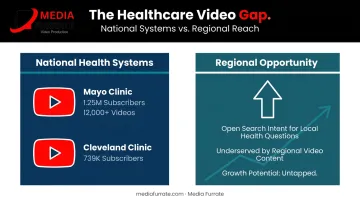
That gap is real, but so is the opportunity. Patients in your market aren't searching for Mayo Clinic — they're searching for answers to local health questions, and a well-optimized regional video presence can capture that intent directly.
Video Does What Written Content Can't
A procedure explainer that walks a patient through what to expect during a diagnostic imaging appointment does something a brochure cannot: it replaces fear of the unknown with familiarity. A 2025 randomized controlled study of 200 patients found that video information reduced procedural anxiety more than verbal and written instructions alone — a direct benefit for organizations focused on improving patient readiness before procedures.
What You Need Before You Start
Skipping pre-production is the single most common reason healthcare video programs underperform. Before a camera comes out, three decisions need to be made clearly.
Define Your Goal
Awareness, patient education, provider recruitment, and appointment conversion each require different video formats, lengths, and platforms. A provider introduction video posted to YouTube without any connection to your scheduling page serves no conversion purpose. A patient testimonial buried on a staff intranet serves no marketing purpose.
Define the goal before anything else. Every other decision — format, length, platform — flows from it.
Understand Your Compliance Environment
HIPAA applies to marketing video, not just clinical records. Any patient who appears in a testimonial or procedure video requires written consent that describes exactly how the footage will be used, on which platforms, and for how long.
Clinical spaces also need careful staging before filming begins. Common sources of exposed patient information include:
- Whiteboards with patient names or room assignments
- Charts and clipboards left on counters
- Monitor screens visible in the background
- Patient intake forms on desks or nurse stations
Assess Your Production Approach Honestly
Not every healthcare video needs the same production investment. A quick health tip for Instagram Stories can be filmed simply and still land well with viewers. But patient testimonials, physician introductions, and facility overviews are trust-sensitive — poor lighting or muddy audio signals to a prospective patient that the organization doesn't take itself seriously.
Working with a production team that has direct healthcare experience reduces costly on-set delays. Media Furrate, based in Baton Rouge and serving healthcare organizations across the Gulf South, uses a lean crew model specifically built for hospital and clinic environments. Small crews keep disruption to daily operations minimal, while professional lighting and 4K capture deliver the production quality that builds patient trust.
Types of Healthcare Videos That Drive Results
Patient Testimonial Videos
Authentic patient stories carry a weight that no amount of polished brand messaging can replicate. The reason is simple: they're not coming from you.
What makes a testimonial credible rather than performative:
- Let patients speak in their own words rather than reciting scripted talking points
- Capture real emotional specificity — not "the staff was great," but the moment a patient describes when their anxiety finally lifted
- Invest in professional audio and lighting; low production quality undercuts the authenticity you're building
The logistics matter, too. Written consent must be secured before filming, and a conversational interview setup outperforms a formal on-camera format almost every time.
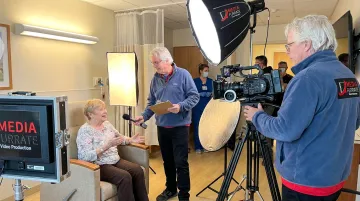
At Media Furrate, the producer stands just off-camera, maintaining eye contact and asking questions in a relaxed way. That approach typically captures everything needed in 12 to 20 minutes — no script required.
Educational and Explainer Videos
Condition explainers and procedure how-to videos perform consistently well in search because they match exactly what patients are already typing. Mayo Clinic's "Explains Hypertension" video has accumulated 337,000 views since its 2022 publication — a four-minute video that continues to earn organic traffic years after production.
Two format decisions worth settling before production:
- Animated explainers work well for internal procedures or concepts that can't be filmed (blood flow, cellular processes, drug mechanisms)
- Live-action works better when you want to build provider credibility and show your actual facility and staff
Provider Introduction Videos
Many patients select a physician before their first appointment — and a short, warm introduction video can meaningfully influence that decision. A 60-to-90-second video showing a physician's personality, care philosophy, and credentials replaces the cold experience of reading a bio page with something closer to an actual first impression.
What to include in a provider intro video:
- A brief personal statement on care philosophy (not credentials alone)
- One specific patient population or condition the provider focuses on
- A natural moment — walking the hallway, speaking with staff — rather than a static talking-head shot
Procedure Walk-Throughs and Behind-the-Scenes
"What to expect" videos replace fear with familiarity. Showing a patient what a diagnostic imaging room looks like, how prep works before a procedure, or what recovery involves turns abstract anxiety into manageable information.
One critical production note: clinical environments require careful staging before filming. Whiteboards, patient charts, monitor displays, and any identifying documentation need to be cleared from the frame before the camera rolls.
Short-Form Awareness Content
Instagram Reels, YouTube Shorts, and similar formats serve a different purpose than your longer educational content. They keep your organization visible between a patient's active research phases — quick health tips, myth-busting clips, seasonal wellness reminders. KFF's 2024 research found that 44% of U.S. adults use TikTok, with 66% having encountered health content there. Short-form healthcare content reaches patients during their everyday scroll. Just make sure your source authority is visible so your content stands apart from the misinformation that's already circulating on the same platforms.
How to Create and Deploy Healthcare Videos Step by Step
Pre-Production: Plan Before You Film
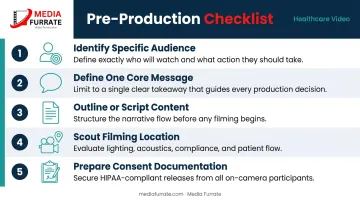
Pre-production decisions determine whether your production time is used efficiently or wasted. Cover these before scheduling a shoot:
- Identify the specific audience for this video — not "patients" but "adults 45-65 researching knee replacement options in your market"
- Define one core message — videos that try to communicate five things communicate none of them
- Outline or script the content — testimonials can be unscripted, but educational videos benefit from a clear structure
- Scout the filming location — assess lighting conditions, background elements, ambient noise, and any privacy considerations
- Prepare consent documentation — written patient consent must be in hand before filming begins, not after
The most common pre-production error is trying to fit too much into one video. A narrowly focused three-minute video will consistently outperform a comprehensive ten-minute one.
Production: Capture Credibly
Three elements affect whether viewers finish your video:
- Lighting quality — flat or dim footage signals low effort and undermines provider credibility
- Audio clarity — TechSmith's 2024 Video Viewer Trends Report found poor audio and blurry footage are tied as the top reasons viewers stop watching; audio problems may cause more abandonment than any other single issue
- Interview or demonstration setup — a conversational, natural setup produces more credible results than a stiff, on-camera performance
The same TechSmith report found 87% of viewers prefer seeing a real person on screen over animated characters or AI avatars. In healthcare, provider visibility directly affects trust — so this isn't a minor preference gap.
Post-Production: Optimize Before Publishing
Post-production for healthcare video goes beyond cutting out dead time. Each video needs:
- Professional editing for pacing — dead air and hesitation gaps lose viewers fast
- On-screen graphics for key facts, provider credentials, and contact information
- Closed captions — required under ADA guidance for healthcare organizations, and they also help YouTube index your content for search
- A thumbnail that clearly communicates what the video covers, not a random freeze frame
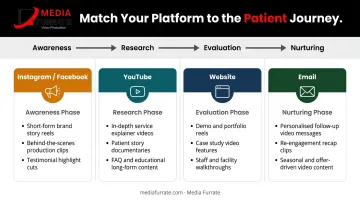
Distribution: Match Platform to the Patient Journey
| Platform | Patient Stage | Best Content Types |
|---|---|---|
| YouTube | Actively researching conditions or providers | Educational explainers, provider intros, procedure walk-throughs |
| Your website | Evaluating a specific service | Testimonials, facility overviews, service-line explainers |
| Instagram / Facebook | Awareness and community | Short-form tips, seasonal content, event coverage |
| Existing patient nurturing | Educational updates, new service announcements |
Tracking: Measure What Matters
View count is not a performance metric. These are:
- Watch time percentage — tells you whether viewers find your content worth finishing
- Click-through rate to a scheduling page or contact form
- Downstream appointment volume attributable to video traffic
A video with 200 views and a 12% scheduling click-through rate is outperforming one with 5,000 views and zero downstream action.
Best Practices for Healthcare Video Marketing
These four practices separate effective healthcare video content from content that gets ignored.
Hook early. Wistia's engagement data shows significant viewer drop-off in the first 10 to 15 seconds when the opening doesn't deliver immediate value. Lead with a direct question, a specific patient outcome, or a visual that establishes context right away. Avoid slow institutional intros.
Cut medical jargon entirely. Patients search in plain language and process information in plain language. Any term that requires a medical dictionary slows comprehension and creates distance.
Repurpose intentionally. A single three-minute educational video can yield:
- A 30-second social clip
- A written blog post from the transcript
- An email newsletter excerpt
- A FAQ page entry
Build this multi-format thinking into production planning. Capturing the right material on shoot day costs far less than returning for additional footage.
Treat accessibility as a baseline. ADA guidance is clear: hospitals and medical offices are public accommodations, and missing captions create accessibility barriers for people with hearing disabilities. Section 508 requirements apply to many healthcare organizations.
Beyond compliance, captions serve patients watching in silent environments and improve search visibility on YouTube.
Frequently Asked Questions
How much does healthcare video marketing cost?
Cost varies based on video type, length, and production approach. Social clips can be low-cost, while patient testimonials and facility overviews benefit from professional investment. A lean crew model delivers professional quality without the overhead of a large agency.
Do I need patient consent to use testimonials or footage in healthcare videos?
Yes. Written patient consent is required before a patient appears in any healthcare marketing video. The consent must specify how footage will be used, which platforms it will appear on, and for how long. HIPAA requirements apply in marketing contexts as well.
How long should a healthcare marketing video be?
Match length to goal: awareness clips under 60 seconds, testimonials and educational videos at one to three minutes, procedure explainers longer if every section earns its time. Wistia's analysis of over 13 million videos found videos under one minute average 52% engagement, with educational content between one and five minutes watched more than halfway through.
What types of healthcare videos get the most engagement?
Patient testimonials and educational how-to videos consistently perform best because they match real patient search intent. They answer questions patients are actively asking, which drives both search discovery and watch completion.
How do I measure whether my healthcare video marketing is working?
Track watch time percentage, click-through rate to scheduling or contact pages, and appointment volume from video-sourced traffic. Raw view count alone doesn't indicate whether a video is actually moving patients toward a decision.
Should healthcare organizations use professional production or film on a smartphone?
Short social clips filmed naturally can feel authentic and relatable. Trust-sensitive content — patient testimonials, physician introductions, facility overviews — requires professional lighting, audio, and editing to maintain the credibility patients expect from a healthcare brand.