The frustration most clients hit: quotes vary wildly, and it's genuinely hard to know what's fair. A $300 shoot and a $3,000 shoot can both be called "drone videography" — but they're not the same thing.
This guide breaks down current pricing ranges, the factors that move costs up or down, what a professional package should actually include, and how to budget confidently for your next aerial video project.
Key Takeaways
- Drone videography rates in 2026 range from $150–$250/hr (basic) to $400–$600+/hr for experienced professionals with full post-production
- Project-based pricing ranges from $300 for simple single-location shoots to $5,000+ for commercial or multi-location productions
- Price reflects pilot experience, FAA licensing, equipment tier, deliverable type, and post-production scope
- Low-stakes aerial needs fit the lower end; commercial, healthcare, or industrial productions belong in the mid-to-premium range
- Bundling drone work into a full production package delivers better value than hiring a standalone operator
How Much Does Drone Videography Cost in 2026?
Drone videography doesn't have a fixed rate. Costs shift based on who you hire, what you need captured, and what the final deliverable looks like. Two budgeting mistakes derail clients before they even start: underestimating scope (a "few aerial shots" still requires planning, compliance, and editing) and comparing quotes without understanding what's included.
Here's how the three tiers break down:
Entry-Level Drone Videography
Typical cost: $150–$300/hr or $300–$600 per project
Entry-level work generally includes:
- Short flight sessions (often under an hour)
- Raw or minimally edited footage
- Consumer or prosumer drone equipment
- Limited deliverables — often just clips, not a finished video
Best for: Property owners who need a quick aerial shot for a listing, social media creators, or projects where a client's in-house team will handle all editing.
The tradeoff is straightforward: you get footage, not a finished product. If your team can't edit, the apparent savings disappear quickly.
Mid-Range Drone Videography
Typical cost: $250–$600/hr or $800–$2,500 per project
Mid-range packages typically include:
- FAA-licensed pilot
- 4K footage with basic color correction
- 1–3 hour shoots
- Clean, usable deliverables ready for deployment
Best for: Marketing teams, real estate brokers, healthcare organizations, and agencies that need polished aerial footage to integrate into a broader video or campaign.
According to UAV Coach's 2026 pricing guide, drone videography runs $200–$500/hr at this tier, with project-based rates typically falling between $1,000 and $5,000 depending on scope and deliverables.
Premium / Full-Production Drone Videography
Typical cost: $400–$600+/hr or $2,500–$5,000+ per project
Premium work includes:
- Experienced FAA-licensed pilot with production background
- Professional-grade 4K+ camera systems
- Scripted or storyboarded shoot with intentional flight paths
- Full post-production: editing, color grading, motion graphics
- Multi-location or complex shoots integrated into a broader production
Ideal for: Industrial companies, PR firms, commercial advertisers, and healthcare systems where aerial footage is a core component of a branded, high-stakes production rather than a supplementary clip.
For a concrete benchmark: Thumbtack's 2025 marketplace data shows a 60–90 second edited real estate video clip runs $400–$450, while a 30-minute 4K production with editing can reach $5,000–$7,000.
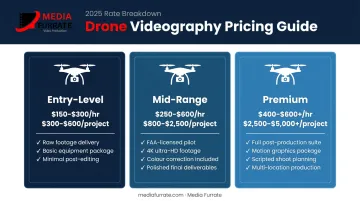
These ranges give you a working baseline — but the tier that fits your project depends as much on your deliverable goals as your budget.
Key Factors That Affect Drone Videography Pricing
Pricing isn't arbitrary. Every line item reflects what the videographer brings to the project and what the project actually demands.
Pilot Experience and FAA Licensing
FAA Part 107 certification is the legal baseline for commercial drone work in the U.S. — not a bonus feature. Unlicensed operators expose clients to legal and financial risk, not just themselves.
Beyond the certificate, experience shows up directly in footage quality. A pilot who understands production — cinematography, storytelling, shot composition — captures usable footage efficiently. A pilot who only knows how to fly may complete a shoot with beautiful footage that doesn't cut together.
Jason Furrate at Media Furrate operates as both FAA-licensed drone pilot and producer/director, which means aerial shots are planned to serve the narrative before the drone ever lifts off.
Equipment and Camera Quality
Professional drone equipment runs $1,500 to over $12,000, and the gap between a consumer drone and a professional 4K aircraft is visible in the footage. Higher-end gear produces sharper images, better stabilization, and more usable footage per flight — but those operational and maintenance costs flow directly into professional rates.
Scope, Complexity, and Location
Several factors push a quote higher:
- Multiple shoot locations or access-restricted sites
- Controlled airspace near airports requiring FAA authorization or waivers
- Extended shoot duration or multi-day productions
- Travel fees for out-of-area locations
The FAA's waiver process for Part 107 deviations — night operations, beyond visual line of sight, controlled airspace — adds compliance work before a single flight happens. That pre-flight planning includes airspace coordination, site assessment, and filing, all of which take real time to execute.
Deliverable Type and Post-Production
This is where most clients underestimate real spend. Deliverable type has a direct impact on total cost:
- Raw footage only — lower upfront cost, but editing falls on the client
- Edited highlight reel — color correction, music, basic cuts included
- Full production integration — scripting, ground footage, interviews, motion graphics, and finished delivery
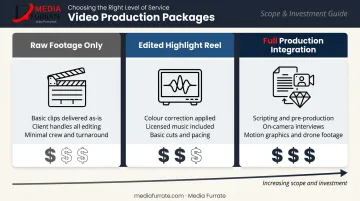
When drone footage is part of a complete production, post-production is often the largest cost component. Clients who compare only "flight time" quotes consistently underestimate what a finished video actually requires.
What's Included in a Professional Drone Videography Package
A legitimate professional brings far more than a drone. Knowing exactly what's included is the clearest way to evaluate competing quotes.
Pre-Production Planning and Compliance
Before a shoot day, professional operators handle:
- Site assessment and airspace authorization checks
- FAA waiver requirements for restricted locations
- Shot list or storyboard development
- Weather contingency planning
- Local permit confirmation
This unseen preparation is what separates reliable professionals from operators who just show up and fly. Skipping it is how shoots get grounded mid-day or produce footage that can't legally be used commercially.
Flight Execution and Footage Capture
On shoot day, the difference between a planned shoot and improvised flying shows up immediately in the edit. Intentional flight paths, pre-determined shot angles, and a pilot who understands how footage will cut together produces significantly more usable material within a given shoot window.
For productions where aerial footage needs to integrate with ground-level interviews, b-roll, and branded graphics — like the commercial work Media Furrate handles for clients across Baton Rouge and the Southeast — having the drone pilot and producer/director be the same person eliminates the coordination gap that produces disjointed aerial segments.
Insurance, Licensing, and Legal Compliance
Drone insurance isn't legally required under Part 107 in the U.S., but it's standard practice for commercial work — and clients should expect it. Typical commercial drone liability policies provide $1M in coverage, with some clients requiring $2.5M or higher.
Working with an uninsured or unlicensed operator creates legal exposure for your organization, not just the pilot. The FAA proposed $341,413 in civil penalties against 27 individuals for drone violations between October 2022 and June 2024, with fines now reaching up to $75,000 per violation under the FAA Reauthorization Act of 2024.
Before signing any contract, verify:
- FAA Part 107 certification
- Proof of liability insurance
- Documentation of airspace authorizations (if applicable)
Pricing Models: Hourly, Package, and Project-Based
| Model | Best For | Trade-off |
|---|---|---|
| Hourly | Short shoots, variable scope, simple deliverables | Can escalate if scope isn't well-defined upfront |
| Package | Clients with recurring needs and predictable deliverables | Requires clear agreement on what's included |
| Project-based | Commercial, industrial, or integrated video productions | Requires thorough brief and contract to control scope creep |
For most commercial or industrial clients, project-based pricing is the right frame: it covers pre-production through delivery and prevents surprise line items at the end.
For complex productions, bundling drone services into a full production package is usually the smarter call. Splitting work across two vendors — a separate drone operator and a video production company — introduces hidden costs that rarely appear in either quote on their own:
- Coordination overhead between two schedules and two contacts
- Version control issues when aerial footage and ground footage are edited separately
How to Choose the Right Drone Videographer for Your Budget
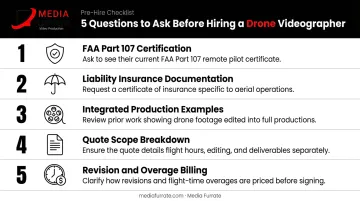
Questions to Ask Before Hiring
- Are you FAA Part 107 certified? Ask for documentation — not just a yes.
- Do you carry liability insurance? Request a certificate, not a verbal assurance.
- Can I see examples of aerial work integrated into full productions? Raw flight reels don't show how footage performs in an edited piece.
- What does your quote include? Flight time only, or edited deliverables?
- How are revisions and additional shoot time billed?
Red Flags Worth Walking Away From
- No license or insurance documentation on request
- Vague quotes with no defined scope or deliverables
- Portfolio contains only raw flight clips — no completed productions
- Can't explain their process for restricted airspace or permitting
The cheapest option frequently costs more downstream: re-shoots, re-editing, or legal exposure from unlicensed work. Evaluate value, not just the hourly rate.
That value calculation changes when drone footage is integrated into a full production rather than delivered as a standalone clip. For clients in Baton Rouge and the Southeastern U.S., Media Furrate combines FAA-licensed drone services with scripting, editing, and post-production under one roof — keeping crews small, overhead low, and final deliverables useful to healthcare systems, industrial clients, and marketing agencies.
Frequently Asked Questions
How much does it cost to hire a drone videographer?
Costs range from roughly $150–$300/hr for basic shoots to $400–$600+/hr for experienced professionals with full post-production included. Project-based pricing for commercial work typically runs $800 to $5,000+, depending on scope, deliverables, and production complexity.
What is the difference between hourly and project-based drone videography pricing?
Hourly works for short, simple shoots where duration is variable. Project-based pricing covers a defined scope from pre-production through delivery — better suited to commercial, industrial, or marketing productions where deliverables and budget need to be locked in before work begins.
Do I need to pay extra for edited footage vs. raw drone video?
Raw footage costs less upfront but requires separate editing. Professionally edited, color-corrected deliverables cost more and are almost always what businesses need for marketing or commercial use — the editing cost exists either way; the only variable is whether it's built into your quote or billed separately later.
Why does drone videography cost more than standard ground-based videography?
Drone work adds several costs that ground-based shooting doesn't carry: FAA certification and registration, liability insurance, pre-flight airspace planning, potential waiver requirements for controlled locations, and specialized equipment running $1,500 to $12,000+. Professional rates reflect all of those costs.
What should I ask a drone videographer before hiring?
Ask about FAA Part 107 certification, liability insurance documentation, examples of completed productions (not just raw footage), exactly what the quote includes, and how revisions or additional shoot time are billed.
Is a cheaper drone videographer worth the risk?
Unlicensed or underinsured operators expose your organization to legal liability, and poor-quality footage typically means re-shoots. The "cheaper" option tends to cost more in the long run. Evaluate the full picture: verified licensing, insurance coverage, and whether the quote includes finished deliverables — not just the hourly rate.