Introduction
Commercial property owners face a widening gap between what inspections cost and what they actually document. Scaffolding mobilization is expensive and slow; rope access crews create liability exposure. A written report with a handful of ground-level photos won't satisfy lenders running ASTM-standard due diligence—or investors who expect documented proof of asset condition, not verbal assurances.
Drone inspections close that gap. A single flight can survey a full commercial rooftop, all four facades, rooftop HVAC equipment, and parking structures in hours—producing high-resolution documentation that serves maintenance teams, insurers, and investors from the same footage package.
What follows breaks down what a commercial drone inspection actually delivers—and what's at stake when it gets skipped.
Key Takeaways
- Drone inspections eliminate scaffolding, boom lifts, and rope access crews, cutting costs and keeping workers off fall hazards
- One mobilization covers the full building envelope: roofing, facades, HVAC, drainage, and parking structures
- Timestamped aerial footage supports insurance claims, lender due diligence, and capital planning
- FAA Part 107 certification is required for all commercial drone flights in the US—no exceptions
- Skipping inspections turns manageable defects into expensive emergency repairs
What Is a Drone Inspection for Commercial Real Estate?
A commercial drone inspection uses an unmanned aerial vehicle equipped with a high-resolution camera to conduct a systematic survey of a building's exterior—without anyone stepping onto a rooftop or hanging from a swing stage. The aircraft covers elevated surfaces the same way a trained inspector would, except it does so from the air.
What Gets Inspected
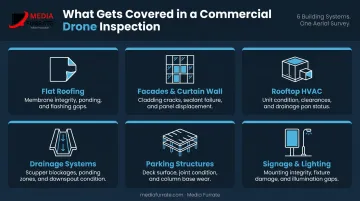
A standard commercial drone inspection typically covers:
- Flat and low-slope roofing — membrane condition, blistering, ponding areas, flashing integrity
- Facades and curtain wall cladding — cracks, sealant failures, spalling, window seal deterioration
- Rooftop mechanical equipment — HVAC units, exhaust fans, curb conditions, penetration seals
- Drainage systems — scuppers, gutters, downspout inlets, and surface drainage patterns
- Parking structures — deck surfaces, expansion joints, column bases, and barrier conditions
- Exterior signage and lighting — mounting condition, visible corrosion, structural attachment points
Thermal-equipped drones extend detection to moisture intrusion and insulation failures that optical cameras can't see. That's critical for buildings with flat roofs that show no visible surface damage yet have active leak complaints below.
Why Documentation Quality Matters
Drone inspections are most valuable when the output serves multiple stakeholders. Fannie Mae's Property Condition Assessment guidelines explicitly accept drone coverage as an acceptable method for inspecting inaccessible flat roofs—and require aerial photos as standard PCA exhibits. That means footage from a well-executed drone inspection can feed directly into lender documentation requirements, not just internal maintenance files.
FAA rules apply to every commercial flight. Part 107 regulations require a Remote Pilot Certificate for any drone operation conducted for business purposes, with a standard altitude ceiling of 400 feet above ground level in uncontrolled airspace.
Working with a licensed operator matters for both compliance and output quality. Media Furrate's FAA-certified pilot operates 4K camera-equipped aircraft across Louisiana and the Gulf Coast, producing documentation that meets professional and lender standards.
Key Advantages of Drone Inspections for Commercial Real Estate
Advantage 1: Elimination of Scaffolding and Access Infrastructure Costs
Before a traditional exterior inspection begins, the access equipment has to show up first. For most mid-size commercial buildings, that means:
- Boom lift delivery, setup, and operator time (often multiple days)
- Swing-stage or scaffolding installation for high-rise facades
- Rope access crew mobilization for complex geometries or occupied buildings
- Traffic and tenant disruption during staging
According to drone service providers, a full commercial building drone survey typically costs $500 to $3,000 per building depending on size and deliverable complexity. Scaffolding mobilization alone often exceeds that figure for a comparable scope. Drone teams typically complete a full survey in hours rather than the one to three days physical access methods require.
The KPIs that change:
- Inspection cost per square foot drops sharply
- Mobilization time shrinks from days to hours
- Tenant disruption is effectively eliminated
- Inspection frequency becomes financially viable at quarterly rather than annual intervals
High-rise office towers, multi-building retail portfolios, and industrial campuses see the clearest gains — these are exactly the property types where staging access equipment creates the most disruption during business hours.
Advantage 2: High-Fidelity Documentation for Asset Management and Due Diligence
A written inspection report with a few photos is a point-in-time opinion. Drone footage is a verifiable, timestamped record of the building's condition, one that doesn't depend on the memory or judgment of a single inspector.
When processed through photogrammetry tools, aerial imagery produces measurable 3D models of building exteriors. That shifts documentation from descriptive to quantifiable — crack widths tracked, membrane blister footprints measured, drainage patterns mapped against roof slope data.
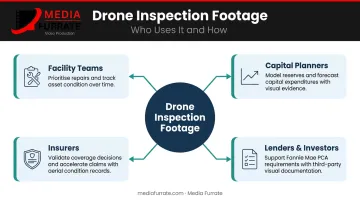
How this documentation flows through the asset lifecycle:
- Facility teams use it to prioritize repair work orders against a visual reference
- Capital planners reference year-over-year comparisons to forecast reserve spending
- Lenders and investors use it during acquisitions — Fannie Mae's Form 4099 requires aerial photos as standard PCA exhibits and accepts drone coverage for otherwise inaccessible flat roofs
- Insurers use pre-event and post-event imagery to resolve damage claims faster and reduce disputes
Risk & Insurance reported that US commercial water damage generated $500 million in annual incurred losses in 2021, with roughly 75% of those losses originating from plumbing, HVAC systems, and other equipment failures. These are the same systems visible on a rooftop drone survey. Having documented pre-loss condition records changes how those claims get resolved.
The documentation value is highest during sale or refinancing, when active insurance claims are in play, or when a portfolio requires consistent condition benchmarking across multiple sites.
Advantage 3: Reduced Safety Exposure and Increased Inspection Frequency
OSHA's fall protection standard (29 CFR 1926 Subpart M) requires fall protection any time workers are exposed to unprotected edges six feet or more above a lower level. Every commercial rooftop access event triggers that requirement.
The safety stakes are real. BLS data shows that in 2023, falls, slips, and trips accounted for 38.5% of all construction deaths — and roofing contractors alone accounted for 110 fatalities tied to fall incidents. Drone inspections remove workers from that exposure entirely for routine condition assessments.
The operational impact is direct:
- Routine assessments that required extensive safety planning can now happen more frequently
- A biennial inspection cycle can shift to quarterly without added budget pressure
- Post-storm assessments can happen within 24 hours, not weeks after a weather event
IFMA's facility management guidance recommends semiannual commercial roof inspections — spring and fall — plus additional assessments after significant wind, hail, or snow events. That frequency is impractical with scaffolding budgets. With drone inspections, it's standard practice.
For properties in Gulf Coast and Southeast US markets, where hurricane and severe weather exposure is a recurring reality, the ability to document post-storm condition quickly has direct implications for insurance claim outcomes.
What Happens When Drone Inspections Are Skipped or Delayed
The pattern is predictable. A small membrane blister goes unnoticed because no one has been on the roof. A flashing seal fails at a parapet. A scupper clogs through a wet fall season. None of it appears in a maintenance log because none of it was inspected.
Then water appears on a ceiling tile in a tenant's space during a rain event.
The compounding consequences of deferred inspections:
- Emergency repair costs multiply when contractors charge urgent mobilization premiums versus planned work
- Insurance claims turn adversarial when there's no documented pre-storm condition to distinguish existing damage from new storm damage
- Lender and investor scrutiny intensifies — Fannie Mae's PCA guidelines require more conservative reserve estimates when roofs are undocumented; condition gaps raise red flags in due diligence
- Tenant liability exposure grows as water intrusion in occupied spaces triggers lease disputes and potential landlord claims
None of these outcomes are inevitable. They're the predictable result of inspection gaps — and the fix is scheduling inspections on a cadence that matches how fast commercial roofs actually deteriorate, not how convenient access happens to be.
How to Get the Most Value from Commercial Drone Inspections
Drone inspections deliver their strongest return when they're scheduled, not reactive. That means building them into the annual facility management calendar—alongside HVAC servicing and fire system testing—rather than waiting for visible damage or a transaction event to trigger a flight.
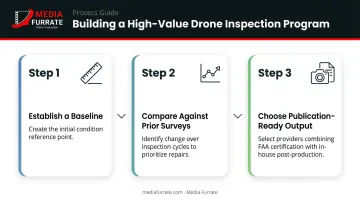
Three practices that separate productive programs from one-off events:
- Establish a baseline: the first inspection creates the condition reference point; everything after measures against it
- Compare against prior surveys: a crack that hasn't changed in two years carries different urgency than one that has widened across three inspection cycles — trend data changes capital planning conversations
- Choose providers who deliver publication-ready output: footage that requires a separate post-production engagement adds cost and delay; look for providers who combine FAA certification with in-house video production, so a single engagement covers maintenance recordkeeping, investor reporting, and insurance files
That last point is where provider selection has real operational impact. Media Furrate combines FAA-certified drone operations with 45 years of professional video production, so inspection footage comes back ready for asset reporting, leasing presentations, and insurance files — no separate editing engagement required. The same footage that serves a facility manager's maintenance log can also go directly into an investor's asset presentation.
For properties across Louisiana and the Gulf Coast, where storm seasons create predictable inspection demand, building a relationship with a licensed provider before an event is far more valuable than scrambling for availability after one.
Conclusion
Drone inspections give commercial real estate operators something traditional methods rarely deliver at a reasonable cost: complete building envelope visibility, consistent documentation, and enough lead time to address defects before they become interior damage events.
The value compounds when inspections run on a regular schedule and the documentation is used. A single post-storm flight or transaction-driven survey captures a moment. A recurring program builds a condition history that delivers real operational advantages:
- Fewer emergency repairs as defects are caught early
- Stronger insurance claims backed by timestamped visual evidence
- Capital planning decisions grounded in documented building conditions
Owners who treat aerial documentation as an ongoing operational tool — not a one-time expense — are consistently better positioned when storms hit, insurance adjusters arrive, or buyers start asking questions. If you're looking to add drone inspection documentation to your property management workflow, Media Furrate's FAA-certified drone team captures the high-resolution footage your team can actually use.
Frequently Asked Questions
Do I need a license to fly a drone for commercial inspections?
Yes. The FAA requires a Part 107 Remote Pilot Certificate for any drone operation conducted for work or business purposes in the US. Part 107 governs airspace access, altitude limits (400 feet above ground level), and operational requirements—and hiring a Part 107-certified provider ensures appropriate liability coverage for the project.
What building systems can a drone inspect on a commercial property?
Drone surveys cover flat and low-slope roofing membranes, facades and curtain wall cladding, rooftop HVAC and mechanical equipment, parking structure decks and expansion joints, drainage systems, and exterior signage. Thermal-equipped drones extend detection to moisture intrusion and insulation failures not visible to standard optical cameras.
How does drone inspection compare to scaffolding-based inspection in cost and time?
Drone teams typically complete a full commercial building survey in hours versus one to three days for scaffolding-based methods. Mobilization costs for physical access equipment run into the thousands of dollars before any inspection work begins—a cost drone engagements eliminate entirely.
Can drone footage be used for insurance claims or investor due diligence?
Yes. Timestamped drone imagery is accepted as supporting documentation for commercial property insurance claims. Fannie Mae's PCA guidelines expressly accept drone coverage for otherwise inaccessible flat roofs and require aerial photos as standard Property Condition Assessment exhibits for lender due diligence.
How often should commercial properties undergo drone inspections?
At minimum annually, with semi-annual inspections, spring and fall, recommended by IFMA's facility management guidance. Properties in hurricane and severe weather regions like the Gulf Coast should add post-storm assessments. That frequency is practical because drone engagements eliminate traditional access mobilization costs.
What should I look for when hiring a commercial drone inspection provider?
Confirm FAA Part 107 certification, experience with commercial building types and heights, equipment capable of 4K or higher resolution capture, and the ability to deliver organized, reportable documentation—not just raw footage.