Introduction
Apparel decoration shops deal with a hazard mix that most operators underestimate. According to BLS data for Commercial Screen Printing (NAICS 323113), the industry records 1.2 total recordable cases and 0.8 DART cases per 100 full-time workers annually — meaning roughly one in every 83 workers misses time or requires job restrictions each year due to a work-related injury or illness.
For a small decoration shop with 10 employees, that's a statistically likely injury every few years. Pair that with OSHA penalties reaching $16,550 per serious violation and $165,514 per willful or repeated violation as of January 2025, and the cost of unpreparedness becomes concrete fast — before factoring in workers' compensation claims, production downtime, or retraining costs.
Those costs trace back to specific hazards. Screen printing, heat pressing, embroidery, sublimation, and vinyl cutting each carry distinct chemical, thermal, mechanical, and ergonomic risks. This guide covers what those hazards are, how to control them by decoration method, and how to build a training program that actually changes behavior on the shop floor.
Key Takeaways
- Chemical safety in screen printing — ventilation, SDS access, proper PPE — carries real OSHA compliance obligations, not just best-practice guidance
- Heat press platens operate at 260–400°F; burn and pressure injuries happen fast when procedures slip
- Embroidery stations carry needle puncture and repetitive strain risks that compound over time without workstation controls
- Flammable solvent storage, waste disposal, and exhaust ventilation carry both safety and EPA/OSHA compliance implications
- Effective safety training is role-specific and regularly reinforced — format matters as much as content
Safety Guidelines for Apparel Decoration
Managing safety in a decoration shop means handling multiple hazard types simultaneously — sometimes at the same workstation. A screen printer exposing screens also handles solvents; a heat press operator faces thermal and pressure risks; an embroiderer deals with both mechanical and ergonomic hazards within a single shift.
The risks vary by type, not just severity. Solvent vapor accumulation in screen printing requires different controls than contact burn prevention at a heat press, or eye strain management at an embroidery station. Training that treats all of these the same way misses the specificity workers need to actually stay safe.
Safety in decoration shops is not a one-time onboarding checklist. It requires ongoing reinforcement, periodic refreshers, and visible protocols that stay practiced — not filed away.
General Safety Precautions
Before getting into station-specific hazards, these baseline requirements apply across all decoration processes:
PPE minimums across all stations:
- Nitrile gloves for any ink or chemical contact
- Safety glasses where splash or projectile risk exists
- Respiratory protection — at minimum N95 for dusty environments, full respirators for solvent-based work
- Slip-resistant footwear on all production floors
Workspace readiness:
- Clear aisle markings and no obstructions near heat equipment or machinery
- First aid kits stocked and accessible at multiple points in the shop
- Emergency eyewash stations within 10 seconds of any chemical handling area
Fundamental handling rules:
- No eating or drinking near ink or chemical stations
- Thorough handwashing before leaving any work area
- Read the SDS for every chemical before first use — no exceptions for "familiar" products
Safety in Screen Printing and Chemical Applications
Screen printing involves some of the most significant chemical exposure risks in apparel decoration. Plastisol inks, discharge inks, emulsion chemicals, screen reclaiming solvents, and ink thinners all carry hazards that workers frequently underestimate.
Key chemical exposure benchmarks to know:
| Chemical | OSHA PEL (TWA) | NIOSH REL (TWA) |
|---|---|---|
| Acetone (screen wash) | 1,000 ppm | 250 ppm |
| Isopropyl alcohol | 400 ppm | 400 ppm |
| Stoddard solvent | 500 ppm | 350 mg/m³ |
| Toluene | 200 ppm | 100 ppm |
| Formaldehyde (discharge) | 0.75 ppm | 0.016 ppm |
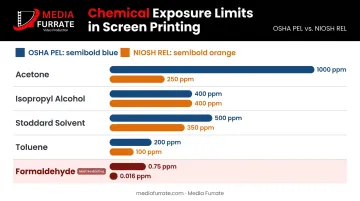
Discharge inks containing zinc formaldehyde sulfoxylate carry formaldehyde exposure limits among the most restrictive in the table above. Many workers handle these products without knowing the chemistry involved — making them one of the higher-risk materials in routine screen printing workflows.
Ventilation: NIOSH guidance on local exhaust ventilation (LEV) in printing operations shows properly installed LEV systems reduce airborne vapor concentrations by up to 83%, with duct air velocity maintained at a minimum of 3,000 feet per minute. Open windows and ceiling fans near solvent work do not constitute a ventilation system. That approach leaves a direct gap in chemical hazard control.
Chemical storage rules (per OSHA 29 CFR 1910.106):
- Maximum 60 gallons of Category 1–3 flammable liquids per storage cabinet
- Maximum 25 gallons of Category 1 liquids in incidental storage outside a cabinet
- Segregate flammables from oxidizers; store all solvents away from heat sources
Waste ink and solvent disposal follows EPA generator categories. Shops generating 100 kg or less of hazardous waste per month qualify as Very Small Quantity Generators (VSQG); those generating 100–1,000 kg/month are Small Quantity Generators with more stringent requirements. Disposing of waste before confirming your generator category can trigger EPA violations — identify your status first.
Safety During Heat-Based Decoration
Where chemical hazards dominate screen printing, heat press and sublimation stations introduce a different threat: thermal injuries that occur faster than most operators anticipate. Platen temperatures in common decoration workflows range widely:
- HTV (heat transfer vinyl): 260–350°F depending on material
- DTG pretreatment/curing (Brother GTX): 356°F at 75–80 psi for 35 seconds
- Polyester sublimation (Sawgrass): 400°F at 45 seconds
At these temperatures, contact burns cause third-degree damage within fractions of a second. Steam burns from moisture trapped in garments add another burn mechanism many operators overlook.
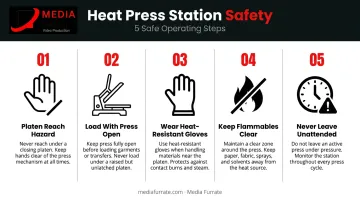
Safe operating procedures at heat press stations:
- Never reach over or under a closing platen
- Keep the press fully open before loading or repositioning a garment — repositioning with the platen raised even slightly is a common injury point
- Use heat-resistant gloves when handling substrates near platens
- Keep flammable materials and loose fabrics clear of the press area
- Never leave a press unattended with a garment loaded under pressure
Pre-shift equipment checks:
- Verify pressure settings and platen alignment before first use
- Check electrical connections for wear or damage; frayed wiring near high-heat components is a compounding hazard
- Remove from service immediately if you notice: inconsistent heat readings, unusual smells, electrical sparks, or platen movement abnormalities
OSHA's accident records include a documented case where a screen-printing employee's arm was pushed into a 590°F flash cure unit, resulting in a third-degree burn and hospitalization. Equipment failures and operator inattention are both in that chain of causation.
Safety in Embroidery and Mechanical Operations
Embroidery is often treated as the "low-risk" decoration method. In practice, it presents different risks than chemical or thermal work — not fewer of them.
Needle hazards:
- Puncture risk during hooping and repositioning is the most common injury vector
- Broken needle fragments can become projectiles — safety glasses are not optional at embroidery stations
- Maintain a broken needle log as a foreign-object control measure; dispose of broken needles in puncture-resistant containers
Ergonomic risks: Repetitive hooping motions, static postures, and poor lighting create cumulative strain that worsens over time. OSHA recognizes ergonomic hazards under the General Duty Clause and has published sewing eTool guidance directly applicable to garment and embroidery operations.
Practical controls:
- Height-adjustable seating at embroidery stations
- Task lighting positioned to reduce eye strain during detail work
- Scheduled micro-breaks — brief, structured pauses every 45–60 minutes — to interrupt repetitive strain patterns
- Machine guarding per OSHA 1910.212 for any rotating components or point-of-operation hazards
Environmental and Chemical Hazard Management
Ventilation and Temperature Controls
Ventilation is the most important environmental control in any decoration shop. Without adequate airflow, chemical vapors from inks, solvents, and adhesive sprays accumulate to hazardous concentrations faster than workers notice.
NIOSH identified 46 different solvents across 29 samples of printing inks — meaning you're rarely dealing with just one vapor when screen printing or cleaning screens.
Temperature and humidity create their own layered risks:
- Heat buildup near curing equipment worsens during summer months in shops without climate control
- High humidity near DTG printers and embroidery equipment can affect ink chemistry and create slip hazards from condensation on production floors
SDS and HazCom Requirements
Every chemical used in a decoration shop requires a current Safety Data Sheet on file and accessible during every work shift. This isn't optional — it's mandated under OSHA HazCom (29 CFR 1910.1200).
Workers must be trained on:
- How to read SDS documents
- GHS/HazCom hazard communication labels (signal words, pictograms, hazard statements)
- Proper PPE selection based on SDS guidance
OSHA requires SDS updates within 3 months and label updates within 6 months when significant new hazard information becomes available.
Fire Hazard Controls
- Store flammable inks and solvents in fire-rated storage cabinets meeting OSHA 1910.106 construction criteria
- Keep flash dryers and heat tunnels clear of ink buildup — accumulated residue is a fire accelerant
- Mount fire extinguishers appropriate for Class B (flammable liquid) and Class C (electrical) fires
- Post and maintain unobstructed evacuation routes
- Reference NFPA 86 for oven, furnace, and dryer fire and explosion hazard mitigation
Common Safety Mistakes to Avoid
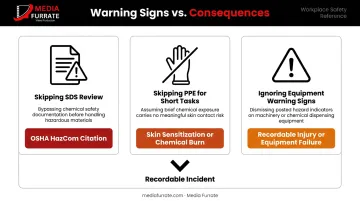
Three patterns account for a disproportionate share of decoration shop injuries and OSHA citations:
1. Assuming familiar products are still safe
HazCom is the top-cited OSHA standard in NAICS 3231 — 31 citations across 14 inspections in FY2025 alone. Shops skip SDS reviews for inks and solvents they've used for years, often without realizing formulations have changed or that newer workers were never informed of the hazards. That assumption creates both a health risk and direct OSHA non-compliance exposure.
2. Skipping PPE for short tasks
"Just a quick touch-up" is one of the most common setups for chemical skin injuries. NIOSH notes that many printing solvents absorb through skin on contact with contaminated surfaces — a direct splash isn't required. Short-duration exposures drive a disproportionate share of skin sensitization events and allergic contact dermatitis cases in printing environments.
3. Dismissing early equipment warning signs
These signals are worth taking seriously before they escalate:
- A heat press showing temperature inconsistencies → unpredictable platen behavior, contact burn risk
- An embroidery machine producing unusual vibration → broken needle or bearing failure pending
- A ventilation fan underperforming → vapor accumulation before anyone notices symptoms
All three patterns share the same underlying failure: treating an early signal as a minor inconvenience rather than a precursor to a recordable incident.
Building an Effective Apparel Decoration Safety Training Program
Generic safety handouts don't change behavior in high-sensory production environments. A screen printer handling emulsion chemicals or a heat press operator managing 400°F platens needs to see the actual hazard, the correct procedure, and the consequence of skipping steps — not read about them on a laminated card.
What a Structured Program Looks Like
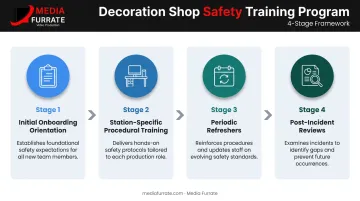
A complete training program for a decoration shop should include:
- Initial onboarding orientation — before any worker handles chemicals or equipment
- Station-specific procedural training — screen printing, heat press, embroidery, and sublimation each get their own module
- Periodic refreshers — triggered by new chemicals, new equipment, process changes, or inadequate worker performance (per OSHA HazCom 29 CFR 1910.1200 and PPE standard 29 CFR 1910.132 retraining requirements)
- Post-incident reviews — to identify what failed and update training accordingly
OSHA's HazCom standard requires training at initial assignment and whenever a new chemical hazard not previously covered is introduced. PPE retraining is required when workplace conditions change, PPE changes, or prior training is demonstrably inadequate. There is no fixed annual mandate — but annual refreshers are standard practice for most shops.
Why Video Training Works in This Environment
Peer-reviewed research on worker safety training methods consistently shows that demonstration-based formats outperform written materials and lectures for complex, hands-on tasks. For decoration shops — where procedures involve real equipment, specific chemical handling steps, and correct PPE application — video training that shows actual processes is far more effective than text-based alternatives.
Professionally produced safety training videos — shot on the actual equipment workers use, showing correct and incorrect technique — deliver several practical advantages:
- Create consistent messaging across all shifts and supervisors
- Are easy to reuse during onboarding without re-briefing every new hire
- Show both correct procedure and common mistakes, so workers understand the stakes
- Can be reviewed for compliance accuracy before distribution
A production partner with industrial safety video experience, like Media Furrate, can help decoration shop owners translate their specific protocols into clear, engaging video content. Their work with industrial clients includes coordinating with legal teams to ensure compliance accuracy — a practical advantage for shops that need training content built around real procedures.
Frequently Asked Questions
What are the safety practices in the apparel/garment industry?
Core safety practices include proper PPE use (gloves, eye protection, respiratory protection), chemical handling per SDS guidelines, machine guarding on cutting and stitching equipment, adequate ventilation in chemical work areas, and department-specific procedures for decoration, finishing, and cutting operations. Fire safety protocols and emergency response plans round out a complete program.
What is the 7-point system in the garment industry?
The 7-point system is a quality inspection method used to evaluate garment construction at key checkpoints throughout production. It's a product quality tool, not an OSHA safety standard. Still, disciplined inspection practices on the shop floor, including broken needle checks, support both product integrity and worker safety habits.
What PPE is required for screen printing and heat transfer work?
Screen printing requires nitrile gloves for ink and solvent handling, safety glasses or face shields for chemical splash risk, and respiratory protection for solvent vapors. Heat press operators additionally need heat-resistant gloves near platens. Specific PPE selection should follow your SDS review and a written hazard assessment per OSHA 1910.132.
What are the main chemical hazards in apparel decoration?
Primary chemical exposure risks in apparel decoration include:
- Plastisol and discharge ink components (including formaldehyde-releasing agents)
- Screen reclaiming solvents such as acetone, isopropyl alcohol, and Stoddard solvent
- Adhesive sprays and sublimation dye vapors at elevated temperatures
All require SDS review, appropriate ventilation, and documented worker training.
How often should apparel decoration safety training be conducted?
Initial training must occur before any worker handles chemicals or equipment. Refreshers are required whenever new chemicals or equipment are introduced, when workplace conditions change, or when worker knowledge or behavior indicates prior training has lapsed. Annual refreshers are common practice in well-run shops, even when no specific change triggers retraining.
What OSHA standards apply to apparel decoration shops?
Applicable standards typically include HazCom (1910.1200) for chemical labeling and SDS, PPE (1910.132) for hazard assessment and protective equipment, Machine Guarding (1910.212), Flammable Liquids (1910.106) for solvent storage, and Lockout/Tagout (1910.147) for equipment servicing and maintenance.