Introduction
Lab accidents happen more often than most students expect. A 2024 Journal of Chemical Education study found approximately 20% of surveyed undergraduate chemistry students had experienced a lab injury — and when incidents do occur, the consequences extend far beyond a first aid kit.
The 2010 Texas Tech chemistry lab explosion seriously injured a graduate student, resulting in the loss of three fingers, eye perforation, and severe burns. At UCLA, a fatal lab fire led to felony charges against the university and a professor. Both incidents trace back to procedural failures that proper training could have prevented.
This guide covers what every student needs to know before entering a lab:
- The core safety practices that protect you
- The most common mistakes to avoid
- What effective lab safety training — including video-based training — actually looks like
Key Takeaways
- Lab hazards — chemical, fire, electrical, and biological — each require a specific trained response
- PPE (goggles, gloves, lab coat, closed-toe shoes) is required before entering any lab space
- Never work alone or eat in the lab; locate all emergency equipment on day one
- Read Safety Data Sheets before handling any chemical and follow disposal protocols without exception
- Video-based training is among the most effective formats for building retention before hands-on work begins
Why Lab Safety Training Is Non-Negotiable for Students
Academic labs aren't exempt from federal oversight. OSHA's Laboratory Standard (29 CFR 1910.1450) requires employers engaged in laboratory use of hazardous chemicals to maintain a written Chemical Hygiene Plan (CHP) covering safety procedures, engineering controls, PPE requirements, employee training, and provisions for particularly hazardous substances. Universities with lab employees — including graduate student workers — fall under this obligation.
OSHA's standard applies to employers and employees, not all enrolled students. Leading institutions go further regardless. Harvard's Chemical Hygiene Plan extends coverage to everyone performing lab work — undergraduates, high school students, TAs, interns, and volunteers. Students entering any research environment should expect that same level of oversight and come prepared for it.
Why Students Face Elevated Risk
Students are a uniquely vulnerable population in lab settings. A 2023 Journal of Chemical Education study surveying 335 university students found measurable gaps in safety knowledge, attitude, and practice. The reasons are predictable:
- First exposure to unfamiliar equipment and chemical hazards
- No ingrained safety-first habits from prior lab experience
- Tendency to defer to peers rather than protocols under social pressure
- Limited understanding of how quickly minor incidents escalate
Structured training before the first hands-on session directly addresses each of these gaps. Without it, students enter the lab without the baseline awareness that keeps routine work from turning dangerous.
Core Lab Safety Guidelines for Students
Lab safety isn't a one-time orientation item. It's applied at every stage: before you start, while you work, and during cleanup.
General Safety Precautions
Before entering any lab session, these baselines apply without exception:
- Wear safety goggles or glasses, chemical-resistant gloves appropriate to the hazard, a lab coat, and closed-toe shoes
- Tie back hair and secure loose clothing before approaching any open flame or rotating equipment
- Read all instructions fully before beginning — not while the experiment is already running
- Keep bench space clear of unnecessary materials and personal items
- Never work alone; always have another person present or within immediate reach
Know where the following are located before you need them:
- Eyewash stations and emergency showers
- Fire extinguishers
- First aid kit and emergency exits
No eating, drinking, gum chewing, or applying cosmetics in the lab — ever. MIT's laboratory guidance is explicit on this, and OSHA's Appendix A to the Laboratory Standard supports it on contamination and ingestion risk grounds. No exceptions.
Handling Chemicals and Hazardous Materials
Chemical handling is where most student incidents occur. The rules here are non-negotiable:
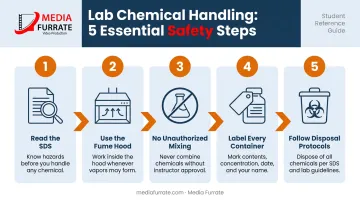
- Read the Safety Data Sheet (SDS) before handling any substance. SDSs cover physical and health hazards, protective measures, and safe handling, storage, and transport procedures.
- Use the fume hood when working with volatile, toxic, or reactive materials. Keep the hood uncluttered — stored materials interfere with airflow and compromise its function.
- Never mix chemicals unless specifically instructed. Incompatible chemicals must also never be stored together.
- Every container needs the chemical name, concentration, and hazard warnings labeled before it leaves your hands.
- Follow disposal protocols exactly. Chemicals cannot be poured down the drain unless explicitly permitted. MIT's guidance restricts drain disposal to materials meeting specific pH and composition criteria — most lab chemicals don't qualify and must be collected as hazardous waste.
Fire, Electrical, and Emergency Safety
Fire extinguisher selection matters. The wrong type can make things worse:
| Fire Class | What Burns | Lab Example |
|---|---|---|
| Class A | Ordinary combustibles | Paper, plastics, bench materials |
| Class B | Flammable liquids | Solvents and liquid reagents |
| Class C | Energized electrical equipment | Hot plates, instruments, power supplies |
| Class D | Combustible metals | Metal powders in advanced labs |
Never leave open flames unattended. Know your evacuation route before you need it.
Response time in emergencies is critical. OSHA's 1992 interpretation states that a worker exposed to chemicals in their eyes must be able to reach an eyewash station within 10 seconds. Princeton's laboratory safety manual specifies flushing for at least 15 minutes after chemical eye contact. Delay directly worsens injury outcomes. Getting there fast is not optional.
Biological and Environmental Safety
For students working with biological materials, the CDC's Biosafety Level (BSL) framework defines appropriate precautions:
- BSL-1: Standard practices for lowest-risk organisms — appropriate for most introductory teaching labs
- BSL-2: Adds controls for moderate-risk agents; possible in supervised higher-education settings with institutional biosafety oversight
- BSL-3/4: Not standard teaching environments
Regardless of BSL level, biological waste must go into labeled biohazard containers — not regular trash. Report malfunctioning equipment or unusual odors to your instructor immediately — don't wait to see if the problem clears on its own.
What an Effective Lab Safety Training Video Should Cover
Reading a safety manual doesn't produce the same result as watching correct technique demonstrated in a real lab environment. Video lets students see hazards before they encounter them, observe proper PPE use and chemical handling in context, and retain procedural sequences more effectively than text-based materials alone.
MIT and edX researchers studying 6.9 million video-watching sessions found that shorter video segments are significantly more engaging — recommending chunks under 6 minutes for maximum retention. That finding shapes how well-designed safety training videos should be structured: focused modules rather than one long presentation.
Core Content a Lab Safety Video Must Include
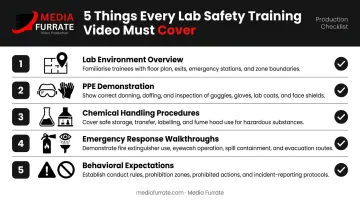
A well-produced lab safety training video should cover:
- Lab environment overview — identifying hazard zones, equipment locations, and workspace layout
- PPE demonstration — correct donning and removal of goggles, gloves, and lab coat shown on camera
- Chemical handling procedures — SDS use, fume hood operation, labeling, and storage rules
- Emergency response walkthroughs — how to use an eyewash station, activate an emergency shower, and operate a fire extinguisher
- Behavioral expectations — what not to do, and why each restriction exists
Why Production Quality Matters
Poor lighting, rushed narration, and shaky framing all reduce comprehension and erode student trust. If a demonstration is filmed too far from the subject or skips past a critical step, students miss the point — and the training fails to do its job. Production quality isn't a cosmetic concern; it directly affects whether the content sticks.
Hiring the right production partner means finding a team that understands both the technical content and how to structure video for an educational audience. Media Furrate has produced safety orientation videos for industrial clients including Crescent Midstream, with a process that includes full script writing and direct coordination with legal teams to ensure accuracy and compliance.
With over 45 years of experience across more than 10,000 productions, Media Furrate's LEAN production model keeps quality high and costs manageable — a practical consideration for institutions working within training budgets.
Common Lab Safety Mistakes Students Make
Three patterns show up repeatedly in student lab incidents.
Skipping or rushing the pre-lab briefing is the most common shortcut. The logic is familiar: "I've done something like this before" or "it'll only take a few minutes." But conditions change — new reagents, different equipment, updated procedures. The pre-lab briefing is the only checkpoint that catches those changes before work begins.
Improvising procedures is where real incidents originate. The 2010 Texas Tech explosion is a documented example: students scaled an energetic material preparation from an understood 100 mg limit to approximately 10 grams, with no formal system in place to communicate or verify that limit. The CSB investigation also found two previous near-misses in the same lab that went undocumented. Protocols encode the lessons from incidents that already happened — skipping them repeats those lessons the hard way.
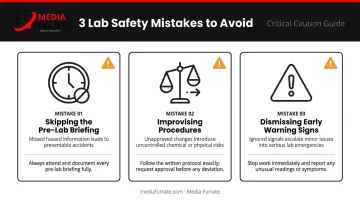
Dismissing early warning signs is the third. Unusual odors, unexpected color changes, equipment running hotter than normal, minor skin irritation — students frequently push through these signals, assuming they're insignificant. Each one means conditions have deviated from expected parameters. Stop, step back, and tell your instructor.
Conclusion
Lab safety comes down to preparation, knowledge, and consistency. Students who know their protocols, wear their PPE without prompting, and treat warning signs as actual warnings protect themselves and everyone working beside them.
For institutions, safety training is an ongoing investment. Training materials need updating. Procedures change. New cohorts of students arrive every semester with no prior lab experience. High-quality video training, refreshed regularly and produced to professional standards, is what closes the gap between checking a compliance box and building habits that stick.
Frequently Asked Questions
What are the most important safety rules for students in a laboratory?
Always wear appropriate PPE (goggles, gloves, lab coat, closed-toe shoes), never eat or drink in the lab, and read all instructions fully before starting. Know where the eyewash stations, fire extinguishers, and emergency exits are located on your first day.
What should a lab safety training video for students include?
An effective video covers correct PPE use, chemical and biological handling procedures, emergency response walkthroughs (eyewash stations, fire extinguishers, evacuation), and behavioral dos and don'ts — all demonstrated in a realistic lab setting.
How often should students complete lab safety training?
Most institutions require training at the start of each academic year or new course. OSHA also mandates training before any new exposure situation, and refreshers should follow any lab incident or significant change in procedures.
Is lab safety training legally required for educational institutions?
OSHA's Laboratory Standard (29 CFR 1910.1450) requires employers using hazardous chemicals in lab settings to maintain a Chemical Hygiene Plan covering training. Educational institutions with covered lab workers — including graduate student employees — must comply.
What PPE is required for standard laboratory work in schools?
The baseline is safety goggles or glasses, nitrile or chemical-resistant gloves, a lab coat, and closed-toe shoes. Specific experiments may require additional protection such as face shields, respirators, or heavier chemical-resistant aprons.
How long should a lab safety training video be?
Effective safety training videos typically run 5–15 minutes depending on scope. Attention tends to drop after 6 minutes, so modular formatting (one topic per segment) tends to outperform a single long video.