Introduction
Roofing kills more workers per capita than almost any other trade. According to the Bureau of Labor Statistics, roofing contractors recorded 110 deaths from falls, slips, and trips in 2023 — representing more than a quarter of all fatal falls in construction that year. Nonfatal injuries compound the cost: roofers suffer falls to a lower level at a rate of 86.9 per 10,000 full-time workers, with a median of 20 days away from work per incident.
For roofing companies, that math translates directly into OSHA citations, workers' compensation claims, and delayed projects. A single serious OSHA violation now carries a maximum penalty of $16,550, and willful or repeated violations can reach $165,514 per citation.
Training is the gap between knowing what the rules say and workers actually following them when they're standing six feet above a concrete surface. Roofing safety training videos are one of the most practical tools for closing that gap. This guide covers what makes these videos effective, what OSHA requires, and how to produce content that workers actually retain and apply on the job.
Key Takeaways
- Roofing is among the deadliest trades, with 110 fatal falls recorded for roofing contractors in 2023
- OSHA requires fall protection training under 29 CFR 1926.503 — video supports documentation and repeatable instruction
- Cover fall hazard identification, PPE inspection, OSHA standards, and weather conditions in every training video
- Modular videos (5–10 minutes per topic) outperform long single sessions for retention and retraining
- Custom-produced content addresses job-specific hazards and holds up better during incident investigations than generic alternatives
Why Roofing Safety Training Videos Are Non-Negotiable
Roofing consistently ranks among the most hazardous trades in construction. Every job involves leading edges, elevation changes, skylights, roof hatches, and variable surface conditions — and there's no version of that work where the risk goes away.
The Documentation Requirement
OSHA's construction fall protection standard, 29 CFR 1926.503, requires employers to train every employee exposed to fall hazards. That training must be conducted by a competent person, and Section 1926.503(b)(1) requires a written certification record with the employee's name, training date, and the trainer's signature.
Video doesn't replace a competent person — but it creates a repeatable, documented training record that supports every OSHA inspection and incident investigation. For roofing companies running multiple crews across multiple sites, that consistency is hard to achieve any other way.
Why Format Matters
Compliance drives the documentation requirement — but format determines whether workers actually retain what they're trained on. Research from MIT's Integrated Learning Initiative found no statistically significant overall advantage for video over reading in post-test performance. Where video pulls ahead is hazard recognition.
A worker reading "inspect your harness before each use" absorbs a rule. Watching someone identify a frayed stitching failure on a D-ring shoulder strap teaches them what to look for — and where. On a roofing crew, that difference shows up in the field, not on a quiz. Leading edges, improper anchor placement, wet membrane surfaces: these hazards are visible. Training that shows them works better than training that describes them.
Reaching a Mixed Workforce
Foreign-born Hispanic workers represent approximately 29% of the construction workforce, according to CPWR. Written safety manuals in English don't reach every worker on a roofing crew. A well-produced training video with visual demonstrations and optional captions communicates across language barriers that text-only materials cannot.
Key Topics Every Roofing Safety Training Video Must Cover
Roofing safety training content should align directly with the causes of roofing fatalities and OSHA's construction fall protection standards. Two OSHA standards — 1926.501 (duty to have fall protection) and 1926.503 (training requirements) — were both cited among OSHA's Top 10 Most Frequently Cited Standards for FY 2025. That tells you exactly where training gaps exist.
Fall Hazard Identification and the Hierarchy of Controls
Before stepping onto any roof, workers must be able to identify every fall hazard present:
- Leading edges and unprotected sides 6 feet or more above a lower level (the OSHA construction trigger under 29 CFR 1926.501)
- Skylights and holes — OSHA 1926.501(b)(4) explicitly covers skylights more than 6 feet above a lower level
- Roof hatches — IBC 1015.7 requires guards when a hatch opening is within 10 feet of a roof edge
- Access and egress points where workers are most vulnerable
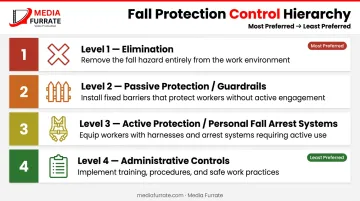
Training videos should walk through a control hierarchy as a decision framework: eliminate the hazard first, then passive protection (guardrails), then active protection (personal fall arrest systems), then administrative controls. Reference 1926.502 for the specific criteria each system must meet.
PPE and the ABCDs of Fall Protection
Harness training is among the most critical topics a roofing safety video can cover. Workers need to see — not just hear — how each component works.
The ABCD framework is a useful structure for this content:
- Anchor — Anchorages must support 5,000 lbs per attached employee, or be designed under qualified-person supervision with a safety factor of at least 2 (OSHA 1926.502(d)(15))
- Body wear — Harness selection, proper fit, and D-ring placement
- Connector — Lanyards, self-retracting lifelines, and clearance requirements
- Descent/Rescue — Communication protocols and rescue plan practice
OSHA 1926.502(d)(21) requires personal fall arrest systems to be inspected before each use for wear, damage, and deterioration. A training video should show exactly what that inspection looks like in practice.
Working Safely in Environmental Conditions
Roof conditions change everything about fall risk. Training videos should address when to stop work entirely, with specific criteria workers can act on — not judgment calls left to each individual.
Surface-specific risks to cover:
- Metal roofing: Condensation creates slip hazards even on mild days
- Flat membrane: Water pooling after rain may not be visible from access points
- Sloped shingles: Steeper angles increase arrest distance and raise anchor load requirements
OSHA's roofing guidance requires suspending operations during high winds, wet weather, or icy conditions. Effective training videos translate that requirement into a concrete go/no-go decision — for example, specifying wind speed thresholds or a pre-shift surface check workers complete before tools come out.
What Makes a Roofing Safety Training Video Actually Effective
Production quality isn't a preference — it's a training outcome. Workers disengage from shaky footage, muffled audio, and cluttered visuals. When the content being communicated is life-critical, losing a worker's attention midway through a segment is a training failure.
Script Quality Determines Retention
The most common production mistake isn't technical — it's the script. OSHA regulatory text is written for legal compliance, not for worker comprehension. A safety training script needs to:
- Sequence information logically so workers build understanding step by step
- Use language that matches the audience — not legal boilerplate
- Demonstrate procedures visually rather than just describing them
Jason Furrate at Media Furrate has been the writer on 99% of the company's 10,000+ productions since 1978. His background in marketing research — phone surveys, focus groups, and real-time audience testing — directly shapes how he translates complex industrial requirements into scripts workers actually absorb.
On-Location Filming vs. Generic Simulations
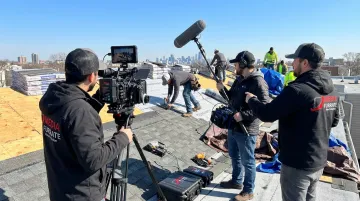
Workers recognize real job sites. Filming on an actual rooftop — with genuine roofing materials, real anchor points, and authentic work conditions — makes hazard recognition training credible in a way studio simulations can't replicate.
Media Furrate's team shoots on location across the Southeastern United States, with a mini-grip van stocked with professional lighting equipment and FAA-certified drone capabilities for aerial perspectives. For roofing safety content, that means capturing actual rooftop conditions, not staged approximations.
Structure matters as much as location. Once you have authentic footage, how you organize it determines whether workers actually retain it.
Modular Format Over Single Long Videos
A 45-minute roofing safety video creates two problems: workers disengage before the critical content arrives, and companies can't target specific retraining without running the entire program again.
Recommended format:
- 5–10 minute modules organized by topic (fall hazard ID, PPE inspection, anchor setup, weather protocols)
- Each module usable independently for targeted retraining
- Easier to update individual segments when regulations or equipment change
Common Mistakes to Avoid in Roofing Safety Training Videos
Content Mistakes
- Covering too many topics in one video — leads to information overload and poor retention
- Narration without visual demonstration — workers need to see the right procedure, not just hear it described
- Showing the wrong behavior without clearly correcting it — confusion about what correct looks like defeats the purpose
- Skipping job-specific hazards — a video about roofing in general misses the specific anchor systems, roof types, and access points your crews encounter daily
Production Mistakes
- Poor audio quality — workers can't retain information they can't clearly hear
- No captions or subtitles — fails a significant portion of the roofing workforce and undermines accessibility
- Outdated equipment in footage — showing PPE or procedures that no longer meet current OSHA standards creates compliance liability rather than reducing it
Organizational Mistakes
The most costly mistake roofing companies make is treating safety training as a one-time onboarding event. OSHA 1926.503(c) requires retraining when workplace changes, equipment changes, or worker behavior indicate a lack of understanding — and that requirement applies whether you're ready for it or not.
Training videos must be refreshed when:
- OSHA updates its standards
- New equipment or systems are introduced
- An incident or near-miss reveals a training gap
- New crews or subcontractors join a project
Conclusion
Done right, roofing safety training videos do more than satisfy OSHA requirements — they reduce fatalities, change on-site behavior, and build a safety culture workers actually follow.
The investment is in quality — professionally written scripts, on-location filming, and modular formats that can be redeployed as conditions change. Generic videos pulled from online libraries won't capture your specific anchor systems, your roof types, or your company's safety procedures.
Media Furrate has been producing industrial safety training videos for over 45 years, with turnkey production services that include scripting, on-site filming, editing, and delivery. If your roofing company needs training content that workers will actually engage with — and that creates a defensible compliance record — contact the Media Furrate team to get started.
Frequently Asked Questions
Are roofing safety training videos required by OSHA?
OSHA requires fall protection training for every employee exposed to fall hazards under 29 CFR 1926.503, but does not mandate video as the specific delivery format. Video fulfills documentation and comprehension requirements effectively and creates a reusable compliance record that supports certification requirements.
What topics should be covered in a roofing safety training video?
Core topics include fall hazard identification, the fall protection control hierarchy, PPE inspection and the ABCD framework, OSHA construction standards (1926.501–1926.503), environmental and weather conditions, and emergency rescue procedures.
How long should a roofing safety training video be?
Shorter modular videos of 5–10 minutes per topic outperform single long videos — they improve retention and let companies deploy targeted retraining without rerunning the entire program.
How often should roofing workers watch safety training videos?
OSHA requires retraining when workers demonstrate a lack of understanding, when new hazards are introduced, or when new equipment is used. Annual refreshers are a widely adopted best practice even when no specific trigger event occurs.
Can roofing companies use generic online safety videos instead of custom ones?
Generic videos may satisfy basic awareness goals but typically miss company-specific hazards, anchor systems, and work procedures. Custom videos are more effective for actual hazard recognition training and more legally defensible during OSHA inspections or incident investigations.
What is the difference between a safety orientation video and a safety training video?
Orientation videos introduce workers to a company's general safety culture and expectations. Training videos teach specific skills and procedures — fall arrest setup, harness inspection, anchor selection — that workers must be able to demonstrate.