
Introduction
According to NIOSH, ladder-related incidents resulted in 161 workplace fatalities and 22,710 injuries in 2020 alone. Those numbers represent real people — and real costs for their employers.
When a worker goes down from a ladder fall, the financial consequences stack up fast. The National Safety Council puts the average workers' compensation cost for falls and slips at $54,499 per claim. Add OSHA penalties — up to $165,514 per willful violation — plus lost productivity, legal exposure, and the strain on remaining crew members, and a single preventable incident becomes a serious operational crisis.
Every one of those incidents was preventable. NIOSH identifies five root causes of ladder falls: wrong ladder selection, incorrect angle setup, skipping inspection, improper use, and lack of safety information. Every cause is fixable with proper training.
The gap between knowing the rules and actually following them is where most accidents happen. Well-structured video training is one of the most direct ways to close it.
Key Takeaways
- Ladder incidents caused 161 fatalities and 22,710 injuries in 2020 — most were preventable
- Safe ladder use requires the right ladder, a pre-use inspection, correct 4:1 angle setup, and three-point contact throughout
- Wet surfaces, uneven ground, and nearby electrical equipment significantly raise fall risk
- The most common causes: ladder movement (40%), base slipping (25%), and missing a step or slipping (24%)
- A custom ladder safety training video shows workers the correct technique in action, which written procedures alone cannot deliver
Ladder Safety Guidelines
Ladder safety isn't a single checkbox — it spans selection, inspection, positioning, climbing behavior, and environmental awareness every time a ladder is used. A crack missed during inspection and a missed pre-use check can each trigger the same outcome: structural failure mid-climb or a fall that sends someone to the hospital.
The severity of any incident ties directly to height, ladder condition, and how consistently the user applies correct technique. That last part is what makes compliance genuinely difficult. Workers must apply these procedures on every use — not just when a supervisor is watching or during formal training sessions.
General Safety Precautions
Before any ladder leaves the storage rack, it needs a visual inspection. OSHA requires inspection before initial use each work shift and more frequently when conditions warrant. Look for:
- Cracked, bent, or corroded rails
- Missing, loose, or damaged rungs
- Broken feet or worn non-slip pads
- Any hardware that's loose or compromised
A damaged ladder must be pulled from service immediately and tagged until repaired or discarded — not set aside "for later."
Personal protective equipment is the next line of defense. Non-slip footwear is non-negotiable. Hard hats apply wherever overhead hazards exist. Loose clothing, improperly worn tool belts, or carrying materials by hand all shift your center of gravity and reduce your ability to react if something slips.
Safe Ladder Setup and Positioning
Extension ladders require the 4:1 angle rule: for every four feet of working height, the base must sit one foot out from the wall. Set too steep, the ladder tips backward. Set too shallow, the feet slide out. Both are common and entirely preventable.
The surface underneath matters just as much as the angle:
- Place ladders on firm, level ground only
- Secure the feet if the surface is hard or slippery
- Never prop a ladder on boxes, pallets, or loose materials to gain extra height
- On soft ground, use a ladder foot spreader or base plate
Safe Ladder Climbing and Use
OSHA's Portable Ladder Safety QuickCard defines three-point contact as two hands and one foot, or two feet and one hand on the ladder at all times. Releasing all three simultaneously — even briefly to reach for something — is a leading trigger for falls.
Behavioral mistakes that get people hurt:
- Overreaching past the side rails (if you can't reach it from where you're standing, come down and move the ladder)
- Carrying tools or materials in both hands while climbing
- Standing on the top two rungs of a stepladder or the top three rungs of an extension ladder
OSHA explicitly prohibits using the top step or cap of a stepladder as a step. Check duty ratings before climbing — ladders must support at least four times the maximum intended load, meaning the combined weight of the worker, tools, and materials.
Environmental and Worksite Safety Considerations
Conditions around the ladder affect risk as much as technique does. Wet or icy rungs, wind, uneven terrain, and proximity to electrical equipment all require specific responses — and sometimes mean the task should wait.
Electrical hazards deserve particular attention. OSHA's construction standard requires ladders with nonconductive side rails when there's any chance of contact with energized equipment. Working too close to overhead power lines can cause burns, shock, or electrocution.
Traffic and movement around a ladder creates its own hazard category:
- Doors that open toward a ladder must be blocked, locked, or guarded
- Equipment movement or foot traffic near the base can displace the ladder without warning
- When displacement risk exists, OSHA requires the ladder to be secured or a barricade placed to keep traffic clear

What Every Ladder Safety Training Video Should Cover
Written procedures and verbal briefings have a real limitation: they describe correct technique but don't show it. Demonstrating three-point contact, the 4:1 angle setup, or a proper pre-use inspection on video makes the correct behavior concrete in a way text never quite manages.
Research backs this up. A peer-reviewed analysis of 95 studies involving nearly 21,000 participants found that higher-engagement training methods produced significantly larger knowledge gains than passive approaches like pamphlets, lectures, or standalone video. The most engaging methods — those combining demonstration, practice, and reinforcement — produced effect sizes nearly three times those of the least engaging methods. Video works best as part of a training system that includes demonstration and behavioral reinforcement, not as a standalone handout.
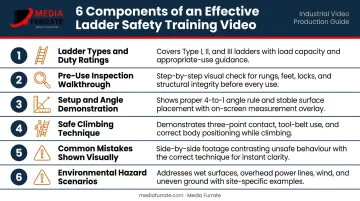
A strong ladder safety training video should cover:
- Ladder types and duty ratings — which ladder is right for which task and load
- Pre-use inspection walkthrough — what to look for, what disqualifies a ladder from use
- Setup and angle demonstration — the 4:1 rule shown on-screen with real equipment
- Safe climbing technique — three-point contact demonstrated by an actual worker, not an animation
- Common mistakes shown visually — overreaching, skipping rungs, standing on the top cap, all depicted so workers recognize them
- Environmental hazard scenarios — wet surfaces, electrical proximity, high-traffic zones
A training video built for a construction crew looks and feels different from one produced for a warehouse team or an offshore facility. The equipment is different, the hazards are different, and workers respond best to scenarios that match their actual environment.
Media Furrate has produced safety orientation videos for industrial clients across the Southeastern United States, including work for Crescent Midstream. Each project starts with understanding the specific environment, workforce, and compliance requirements the video needs to address. With 45+ years of production experience and a team that writes scripts and coordinates with legal teams on safety content, Media Furrate builds training videos tailored to where and how a client's workers actually operate.
Common Ladder Safety Mistakes to Avoid
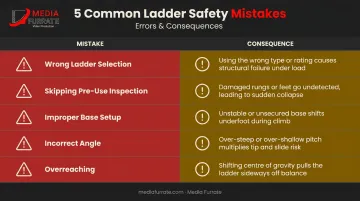
NIOSH identifies five root causes of ladder falls. Each one has a direct fix — and each one is frequently skipped under time pressure.
| Mistake | What Goes Wrong |
|---|---|
| Wrong ladder selection | Type III ladder (200 lb rated) used by a worker plus tools exceeding that limit; rails fail under load |
| Skipping pre-use inspection | A cracked rail or missing rung goes unnoticed until mid-climb — at that point there are no good options |
| Improper base setup | CPWR data shows base slipping in 25% of ladder falls; securing the feet takes 30 seconds |
| Incorrect angle | Too steep or too shallow both increase tip-over or slide-out risk dramatically |
| Overreaching | Shifting weight past the side rails moves the center of gravity outside the ladder's stability zone |
CPWR and Harvard research found that ladder movement accounted for 40% of studied ladder falls — the single largest cause. That's a setup and securing problem, not a climbing technique problem. It's preventable before the first rung is touched.
One pattern worth calling out directly: experienced workers who've used ladders for years without incident are often the ones most likely to skip steps. Not because they're reckless, but because nothing bad has happened yet, so the shortcuts feel fine.
Regular refresher training — especially video-based content that re-demonstrates correct technique — keeps the right behavior visible and top of mind, rather than something half-remembered from an onboarding session three years ago.
That same gap in attention applies to duty ratings, which get overlooked more than almost any other factor. The five rating levels range from Type III at 200 lbs to Type IAA at 375 lbs, and the rating must account for the combined weight of the worker, clothing, tools, and any materials being carried. Ignoring this violates OSHA requirements and can cause sudden structural collapse under load.
Conclusion
Knowing ladder safety rules and actually following them consistently are two different things. Workers need training that shows correct technique clearly — the right angle, the pre-use check, three-point contact throughout — and that training needs to be revisited regularly, not delivered once during onboarding and forgotten.
A professionally produced ladder safety training video protects your workforce, keeps you on the right side of OSHA, and reduces the legal and financial exposure that comes with preventable incidents. If you're considering having one produced, Media Furrate has handled industrial safety video production for companies across Louisiana and the Gulf Coast for over 45 years. Treat it as the operational investment it is.
Frequently Asked Questions
What are the four basic rules for ladder safety?
Always inspect the ladder before use and remove it from service if damaged. Maintain three-point contact while climbing. Set extension ladders at the correct 4:1 angle. Never exceed the ladder's duty rating — account for the worker's weight plus all tools and materials.
What is the 3-point rule for ladder safety?
Three-point contact means keeping two hands and one foot, or two feet and one hand, on the ladder at all times. Releasing all three points at once, even briefly, removes the stability needed to catch yourself if the ladder shifts or a rung slips.
What should a ladder safety training video include?
A complete training video should cover:
- Ladder selection and duty ratings
- Pre-use inspection procedures
- Correct angle setup (4:1 ratio for extension ladders)
- Safe climbing technique with three-point contact
- Load capacity requirements
- Visual demonstrations of common mistakes
Industry-specific scenarios improve knowledge retention.
How often should ladder safety training be conducted?
OSHA requires retraining as necessary to maintain worker knowledge and safe practice — there's no fixed annual interval. Most safety professionals recommend annual refresher training, and retraining is especially warranted after any incident or when new equipment is introduced.
What are OSHA's requirements for ladder safety training?
Construction employers must follow 29 CFR 1926.1060, which requires training on fall hazards, correct ladder use and placement, load capacity, and setup procedures. General industry falls under 29 CFR 1910.23. In both cases, employers must ensure workers understand the hazards specific to their role.
What are the most common causes of ladder accidents at work?
CPWR research identified ladder movement (40%), missing a step or slipping (24%), and losing balance (18%) as the leading causes. Base slipping accounts for 25% of injuries in follow-back studies. Most trace back to improper setup, skipped inspection, or incorrect climbing technique.