Introduction
Machine shops are among the most physically unforgiving work environments. Workers operate high-speed lathes, grinders, hydraulic presses, and milling machines — equipment that can remove a finger in a fraction of a second if something goes wrong.
The stakes are real. According to OSHA's Machine Guarding eTool, workers who operate and maintain machinery suffer approximately 18,000 amputations, lacerations, crushing injuries, and abrasions — plus over 800 deaths — every year. That figure covers all machinery-related incidents across industries, and machine shops sit squarely in that risk profile.
Traditional safety training struggles to match this level of hazard. Verbal onboarding gets forgotten. Printed manuals go unread. In-person demonstrations can't be repeated on demand or standardized across shifts. Machine shop managers are increasingly turning to video-based training to close those gaps.
This guide covers why video training works, what every machine shop safety video must address, how to tell effective videos from ineffective ones, and how to implement them for OSHA compliance.
Key Takeaways
- 18,000+ machinery injuries and 800+ deaths occur annually — consistent video training directly reduces that risk
- Effective safety videos cover machine guarding, lockout/tagout, PPE, hazard recognition, and emergency response
- Modular videos (5–15 minutes per topic) outperform single long-format sessions for retention and retraining flexibility
- Custom videos tied to your actual equipment and facility land harder than generic off-the-shelf alternatives
- Video-based training creates the audit trail OSHA requires during inspections
Why Machine Shop Safety Training Videos Are Non-Negotiable
The Limits of Traditional Training
Human memory doesn't hold onto new information for long — that's the core finding behind the Ebbinghaus forgetting curve, which research published in 2015 confirmed tracks rapid memory decay across intervals from 20 minutes to 31 days. Verbal safety instructions during onboarding fall victim to this decay quickly.
Printed manuals face a different problem: most workers don't read them. And in-person demonstrations can't be standardized across multiple shifts or repeated every time a new hire starts. One supervisor explains it one way; another explains it differently. Those inconsistencies matter in environments where procedural deviation causes injuries.
What Video Training Solves
Video training addresses the consistency problem directly. Every worker — whether they're on first shift or third, hired in January or August — receives the same visual demonstration of the same hazard, explained the same way.
Three practical advantages follow from that consistency:
- Repeatability — Workers can review specific procedures before a task, after an incident, or during refresher cycles without requiring a trainer to be present
- Scalability — A safety video produced once can onboard 5 workers or 500 without additional trainer time
- Documentation — Video-based training platforms track who completed what, when, and how they scored on comprehension checks — creating an audit trail that paper sign-in sheets can't replicate
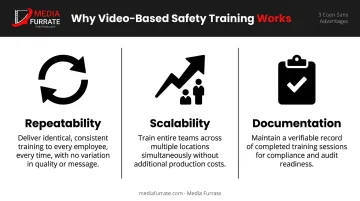
For multi-shift facilities or operations experiencing growth, that scalability alone justifies the investment. Repeatedly staging live demonstrations costs trainer time, produces variable results, and leaves no record of who actually understood the material.
Key Topics Every Machine Shop Safety Video Must Cover
Not all safety content carries equal weight. These five topics are non-negotiable in any machine shop training program.
Machine Guarding
OSHA's 1910.212 standard requires guards on all machines with exposed moving parts that present cutting, shearing, or crushing hazards. Machine guarding ranked #10 on OSHA's FY2025 most frequently cited standards list, with 1,239 violations recorded.
A machine guarding video should show:
- What proper guards look like on specific equipment types
- How to inspect guards before starting a machine
- What to do when a guard is damaged, missing, or removed
- Examples of point-of-operation hazards on lathes, mills, grinders, and presses
Lockout/Tagout (LOTO)
Lockout/tagout ranked #4 on OSHA's FY2025 citation list with 2,177 violations — making it one of the most persistent compliance failures in manufacturing. OSHA 1910.147 requires employers to train workers to recognize hazardous energy sources and apply energy control procedures before maintenance begins.
Generic diagrams don't work here. LOTO training videos should show the actual energy isolation points on the specific machines workers will service — not hypothetical equipment in a generic shop environment.
PPE Requirements
OSHA 1910.132 requires workers to demonstrate they understand PPE requirements before performing work. A video covering machine shop PPE should address:
- Safety glasses and face shields (required near flying chips, sparks, or coolant splash)
- Hearing protection for high-noise operations
- Steel-toed boots for foot injury prevention
- Cut-resistant gloves — with a clear caution that loose gloves near rotating machinery create entanglement hazards, as OSHA Publication 3170 specifically warns
The video should demonstrate correct donning, doffing, and inspection, not just list what PPE is required.
Hazard Recognition and Reporting
Workers encounter hazards that fall outside their formal training — worn guards, unusual machine sounds, coolant leaks, improperly staged workpieces. A structured hazard recognition process closes that gap. Training videos for this topic should walk workers through:
- Recognizing physical hazards (damaged guards, leaking fluids, blocked walkways)
- Identifying behavioral hazards (improper tool use, skipped PPE, unauthorized machine adjustments)
- Using the facility's specific reporting system — who to notify, what form to use, and expected follow-up
- Understanding that near-misses require reporting, not just incidents with injuries
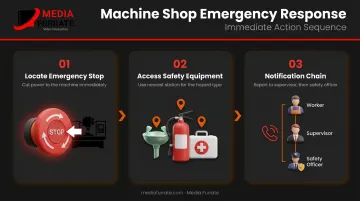
Emergency Response
Generic emergency procedure descriptions fail when workers can't map the steps to their actual workspace. Facility-specific footage anchors the training in reality. An effective emergency response video should show:
- Exact locations of emergency stops and E-stop buttons on the shop floor
- Where eyewash stations, fire extinguishers, and first aid kits are positioned
- The specific chain of notification — supervisor, safety officer, and emergency contacts
What Makes a Safety Training Video Actually Work
Show the Hazard, Then Show the Correct Way
The most effective industrial safety videos use a deliberate before-and-after structure. Showing a worker's hand approaching an unguarded spinning blade — then cutting to the correct guarded setup — creates a contrast that narration alone cannot replicate. Text can describe a hazard; video makes it immediate and difficult to dismiss.
A peer-reviewed review of worker safety training methods found that more engaging training approaches produced stronger knowledge and safety-performance outcomes than passive methods like reading or lecture. Visual demonstration moves training closer to the effective end of that spectrum.
Keep It Facility-Specific
Generic stock footage of "a machine shop" disconnects workers from the training. When the equipment on screen is the same equipment they operate every day, comprehension and buy-in improve. OSHA's own safety management guidance states that training should cover site-specific hazards and controls — not just general principles.
This is where custom-produced videos earn their cost. Media Furrate, which has produced industrial safety content for clients including Crescent Midstream, develops scripts through direct collaboration with client teams and their legal departments — incorporating actual equipment, real facility layouts, and the specific procedures workers need to follow.
Length and Format
Research from a 2014 MIT study of 6.9 million video-watching sessions found that median engagement time rarely exceeded 6 minutes regardless of total video length, with viewers watching less than half of videos longer than 9 minutes.
The practical takeaway: break training into modular videos of 5–15 minutes per topic. Shorter, focused modules:
- Allow targeted retraining (assign just the LOTO module after a near-miss, not the full 60-minute program)
- Reduce cognitive overload during initial onboarding
- Make completion tracking more meaningful
Production Quality Matters
Poor audio, dark visuals, and stilted narration all reduce comprehension — and in safety training, poor comprehension has real consequences. Effective machine shop safety videos need:
- Close-up shots of machine components, guards, and control points
- Clear narration paced for understanding, not speed
- Purposeful editing that guides attention to what matters
- Consistent lighting so details read clearly on any screen
That production discipline is harder than it looks. Jason Furrate of Media Furrate has spent 45 years researching how audiences process information on screen — through focus groups, real-time response testing, and over 10,000 productions — and applies that directly to scripting and pacing decisions for industrial safety content.
Embed Comprehension Checks
Brief quizzes embedded after each module — or administered through a learning management system (LMS) — turn video into active learning and generate the documentation OSHA requires. Tracking completion alone isn't sufficient; comprehension checks confirm the content actually landed.
A well-structured LMS setup also lets supervisors:
- Assign specific modules by job role or hazard exposure
- Flag incomplete or failed assessments for follow-up
- Pull records quickly during an OSHA inspection
Custom vs. Off-the-Shelf Safety Training Videos
| Off-the-Shelf | Custom | |
|---|---|---|
| Cost | Lower upfront | Higher upfront, lower long-term |
| Content | General regulatory topics | Facility-specific equipment and procedures |
| LOTO coverage | Generic diagrams | Actual energy isolation points |
| Worker relevance | Moderate | High |
| Compliance value | Foundational | Comprehensive |
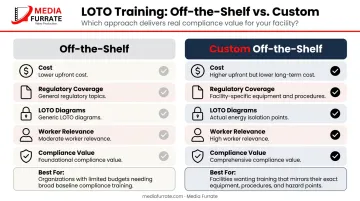
The table above captures the core tradeoff. Off-the-shelf programs work well for foundational content — OSHA rights, general PPE concepts, broad hazard categories. They fall short the moment training needs to reflect a specific machine model, a unique CNC configuration, or a facility's custom emergency procedures.
Custom video production makes sense when:
- Your machinery configurations are non-standard
- You run specialized operations (EDM, large-format grinding, high-volume CNC)
- Employee turnover requires frequent onboarding
- A specific piece of equipment has been involved in incidents
Many facilities use a hybrid approach: off-the-shelf modules for broad regulatory topics, custom videos for facility-specific procedures and new equipment introductions. Media Furrate works with industrial clients throughout Louisiana and Texas using a lean, on-location production approach that keeps custom video costs manageable without sacrificing quality.
OSHA Compliance and Training Records
What OSHA Requires
Several standards directly impose training and documentation requirements on machine shops:
- 1910.147 (LOTO) — Employer must certify training was completed; certification must include each employee's name and training dates
- 1910.132 (PPE) — Written certification required per employee, including training date and subject
- 1910.217 (Mechanical Power Presses) — Training certification must identify the employee, be signed by the trainer, include the training date, and be maintained for the duration of employment
No blanket annual retraining requirement applies to all machine operators under 1910.212. Retraining is triggered by specific conditions.
LOTO Retraining Triggers (1910.147)
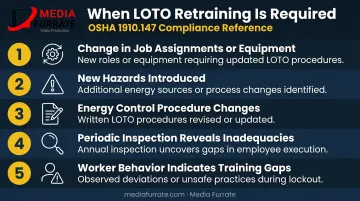
OSHA requires retraining when any of the following occur:
- Change in job assignments or equipment
- New hazards are introduced
- Energy control procedures change
- Periodic inspection reveals inadequacies
- Worker behavior or knowledge indicates training gaps
How LMS Platforms Simplify Compliance
Video-based training delivered through an LMS automatically records who completed each module, the date, and assessment scores. That's the audit trail OSHA inspectors look for — timestamped, employee-specific, and far easier to produce than a paper sign-in sheet from a group session held two years ago.
That same system also makes targeted retraining fast. A modular video library lets you:
- Assign a specific module immediately after a near-miss incident
- Retrain individual employees without pulling the whole team off the floor
- Document completion the moment the employee finishes the module
Frequently Asked Questions
What OSHA standards apply to machine shop safety training?
The primary standards are 1910 Subpart O (machinery and machine guarding, including 1910.212), 1910.147 (lockout/tagout), and 1910 Subpart I (PPE, including 1910.132, 1910.133, 1910.136, and 1910.138). Training requirements are embedded within each standard and carry separate documentation obligations.
How long should a machine shop safety training video be?
Modular videos of 5–15 minutes per topic work best. Shorter, focused modules improve retention and allow targeted retraining after incidents or equipment changes, without pulling workers through an unrelated hour-long session.
What topics must be covered in machine shop safety training videos?
At minimum: machine guarding, lockout/tagout procedures, PPE requirements (including rotating machinery glove cautions), hazard recognition and reporting, and emergency response procedures including emergency stop locations and eyewash stations.
How often should machine shop workers complete safety training?
Initial training is required before operating machinery. Retraining is required after incidents, new equipment introductions, procedure changes, or when observed behavior suggests a training gap. Mechanical power press operators under 1910.217 must train at least annually for PSDI operations.
What is the difference between custom and off-the-shelf safety training videos?
Off-the-shelf videos cover general safety concepts applicable to most facilities. Custom videos are produced using your actual equipment, facility layout, and specific procedures — increasing relevance, comprehension, and compliance value for your specific workforce.
Can machine shop safety training videos replace in-person training?
Video training delivers consistent, documented instruction that's difficult to replicate with classroom methods alone. For best results, pair video modules with a supervisor walkthrough or skills verification to confirm workers can apply what they've learned on the floor.