Introduction
Manual handling injuries cost workplaces more than money — they sideline experienced workers, disrupt operations, and compound over time. According to the 2025 Liberty Mutual Workplace Safety Index, overexertion involving outside sources — largely tied to manual material handling — ranks as the #1 cause of serious workplace injuries, costing U.S. employers $13.7 billion annually.
That figure only covers direct injury costs. Add in lost workdays, workers' compensation claims, reduced output, and potential OSHA exposure, and the real cost is far greater.
Lifting becomes high-risk when safeguards are skipped or training is inadequate. Yet most lifting injuries are preventable. This guide covers proper technique, environmental risk factors, common mistakes, and what a credible workplace lifting safety training program actually requires.
Key Takeaways
- Back injuries and musculoskeletal disorders (MSDs) are among the most expensive and preventable workplace injuries
- Safe lifting requires proper posture, load assessment, core engagement, and keeping the load close — bending your knees is just the start
- Environmental hazards like wet floors, confined spaces, and repetitive task schedules significantly compound individual lift risk
- Mechanical aids should replace manual lifting when loads exceed 50 lbs or require awkward, contorted postures
- Lifting safety training works only when it's ongoing, role-specific, and demonstrated physically — not distributed as a one-time handout
Why Workplace Lifting Safety Training Matters
OSHA does not have a dedicated ergonomic lifting standard — the original rule was rescinded in 2001 and cannot be reissued in substantially the same form without congressional authorization. But that does not mean employers are off the hook.
Under OSHA's General Duty Clause, Section 5(a)(1), every employer must provide a workplace "free from recognized hazards that are causing or are likely to cause death or serious physical harm." Unsafe manual handling qualifies. OSHA has cited employers for ergonomic hazards — including improper lifting, repetitive motion, and awkward postures — directly under this clause.
Lifting Injuries Happen Everywhere
Many organizations assume lifting injuries are a warehouse or manufacturing problem. They're not.
- Healthcare workers face high manual handling risk from patient transfers and repositioning
- Construction crews deal with irregular loads, constrained spaces, and variable terrain
- Retail employees lift stock repeatedly throughout shifts with little formal guidance
- Office workers move equipment, boxes, and supplies with essentially no training
The Business Case
Lifting injuries carry real financial weight. The Liberty Mutual 2025 Workplace Safety Index puts overexertion at the top of the serious injury cost chart. According to the NSC, overexertion, repetitive motion, and bodily conditions caused 492,140 days-away-from-work cases in 2023–2024.
Each case means a vacancy to fill, a claim to manage, and an experienced worker sidelined — costs that structured lifting training can directly reduce.
Workplace Lifting Safety Guidelines
Safe lifting is a sequence of decisions, not a single motion. Skipping the pre-lift assessment, rushing the set-down, or ignoring the carry path all increase injury risk, even when the lift itself looks technically correct. Safety depends on physical discipline and environmental readiness working together.
General Safety Precautions
Before any lift begins:
- Know the weight and dimensions of the load — never assume a box is light based on its size
- Determine whether the task requires help (a second person or a mechanical aid, not just muscle)
- Clear and inspect the travel path for dry flooring, adequate lighting, and no obstacles between start and destination
On appropriate PPE:
- Gloves improve grip on slippery or sharp-edged loads
- Supportive, slip-resistant footwear reduces fall risk during carries
- Back support belts can provide supplementary support but are not a substitute for proper technique and should not create false confidence
Proper Lifting Techniques Step by Step
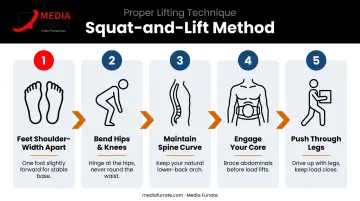
The squat-and-lift method is the standard baseline. Done correctly:
- Position your feet shoulder-width apart, one foot slightly forward
- Bend at the hips and knees (not the waist)
- Maintain the natural curve of the spine throughout the descent
- Engage the core before the load leaves the ground
- Push through the legs to rise, keeping the load as close to the body as possible
Head position matters. Eyes forward, chin slightly tucked, shoulders stacked over hips. Avoid letting the head drop or crane upward as both positions compromise spinal alignment.
Never twist the torso while holding a load. Spinal rotation combined with load-bearing is one of the leading biomechanical causes of disc herniation and muscle tears. To change direction, pivot the feet.
Alternative lift types for specific situations:
- Lunge lift : used for heavy or uneven loads like bags and sacks; requires trained technique
- Golfer's lift : for retrieving small or light objects from low surfaces; involves extending one leg behind for counterbalance
Both require prior instruction before use on the job.
For team lifts, designate one person to call all movements before the lift begins. Both lifters must move in sync because an unannounced shift in direction is enough to cause sudden load imbalance and acute injury.
Carrying and Setting Down Safely
Carrying safely means maintaining the same posture used during the lift:
- Load held close to the waist
- Shoulders aligned with hips
- Direction changes made by pivoting the feet, not rotating the trunk
The set-down is the reverse of the lift and it gets skipped or rushed more often than any other phase. The correct process:
- Approach the destination surface and position your feet
- Squat by bending at the knees and hips, spine neutral
- Lower the load with controlled leg movement
- Release only once the load is fully supported
Dropping the final few inches is a common injury source. The back is still under load until contact is complete.
Environmental and Ergonomic Factors That Affect Lifting Safety
A technically correct lift can still result in injury if the environment creates unexpected hazards. Three categories deserve specific attention.
Floor and Space Conditions
Wet, uneven, or cluttered floors turn a manageable lift into a slip risk. Tight aisles, low-clearance areas, and poor lighting force awkward postures — bent wrists, twisted torsos, elevated loads — that multiply injury risk.
NIOSH ergonomic guidelines for manual material handling identify poor environmental conditions — including inadequate lighting, extreme temperatures, and constrained work areas — as factors that increase workers' chances of developing MSDs independent of the lift weight or technique.
That means assessing lighting, floor conditions, and space constraints before assigning a task — not after someone gets hurt.
The Cumulative Loading Problem
A single lift at a manageable weight rarely causes serious injury on its own. Repeated lifting across a shift — without adequate rest breaks, without posture resets, without task rotation — is a different story.
Research on cumulative spinal loading shows long-term manual material handling exposure is associated with lower-back disorders, with a reported odds ratio of 1.66. The risk from repetition compounds across days, weeks, and years.
Effective training needs to address repetition schedules, task rotation, and recovery time — not just how to lift correctly in a single instance.
When to Use Mechanical Aids
Mechanical aids — dollies, hand trucks, pallet jacks, conveyors — are not last resorts. They are the preferred solution when:
- The load exceeds safe manual handling thresholds
- The load's shape, weight distribution, or surface makes secure grip difficult
- The carry distance is long
- Floor conditions, confined spaces, or elevated delivery points create awkward postures
Mechanical aid availability has to be built into safety planning from the start. If workers can't access the right equipment quickly and easily, it won't get used — and the injury risk remains.
Common Lifting Mistakes to Avoid
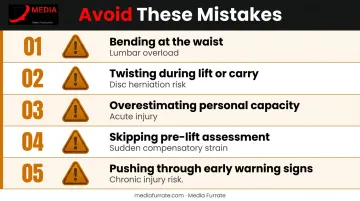
These five mistakes account for the majority of preventable lifting injuries:
- Bending at the waist dramatically increases disc compression by shifting the full load onto the lumbar spine rather than distributing it across the legs and glutes
- Twisting during a lift or carry — combining spinal rotation with load-bearing is a primary mechanism of disc herniation and muscle tears; always pivot the feet instead
- Overestimating individual capacity — workers often push past their safe limit to avoid delays or appear capable; supervisors should set clear weight thresholds and normalize asking for help
- Skipping the pre-lift assessment — an unexpectedly heavy or off-center load causes sudden compensatory movements that produce acute injury; a few seconds of assessment prevents this
- Muscle fatigue, tightness, or discomfort during lifting are signals, not inconveniences — pushing through early warning signs significantly increases the likelihood of serious injury
Workers who flag discomfort before it becomes a strain protect themselves and reduce the employer's long-term claim exposure.
What an Effective Workplace Lifting Safety Training Program Should Include
A credible training program covers more than technique. Core topics must include:
- Health risks of improper manual handling and cumulative MSD exposure
- Ergonomic principles applied to the specific tasks workers actually perform
- Step-by-step technique instruction with physical demonstration
- How to identify elevated-risk lifting tasks before starting them
- Procedures for reporting injuries, near-misses, and early discomfort
Why Demonstration Matters More Than Reading
Written materials and checklists have value, but lifting technique cannot be learned by reading about it. Workers need to see correct form, practice it, and receive corrective feedback before habits form on the job. An instructor circling the room correcting posture during a live drill is irreplaceable.
Well-produced safety training videos fill a critical gap here. They demonstrate proper mechanics from multiple angles, can be paused for group discussion, and can be replayed during refresher sessions without scheduling an instructor.
For industrial and healthcare clients, Media Furrate has produced safety orientation videos — including content for Crescent Midstream — through a process that covers script development and legal team coordination to meet compliance requirements.
Why Generic Training Fails Different Job Roles
Generic one-size-fits-all training fails. A warehouse picker, a healthcare aide transferring patients, and a construction worker unloading materials face fundamentally different environments, load types, and postural demands. Training built around their actual job tasks is more likely to change behavior on the floor.
Training Must Be Ongoing
Lifting safety training is not a one-time onboarding requirement. Back injuries occur among workers who were trained years ago and whose technique drifted back toward habit over time. An effective program includes:
- Initial training at onboarding
- Annual refresher sessions at minimum
- Retraining following any lifting-related incident or job role change
- Ongoing supervisory observation and correction between formal sessions
Technique drift is gradual and hard to self-diagnose — which is exactly why supervisory observation between formal sessions matters as much as the training itself.
Frequently Asked Questions
What is the maximum weight a worker should lift manually in the workplace?
OSHA does not set a universal weight limit. The NIOSH Lifting Equation uses a 51-lb load constant under ideal conditions to calculate a task-specific Recommended Weight Limit — this is a technical screening tool, not a legal maximum. Real-world RWLs are typically much lower once task variables like posture, frequency, and distance are applied.
What does OSHA require regarding safe lifting in the workplace?
OSHA has no specific ergonomic lifting standard, but the General Duty Clause obligates employers to address recognized hazards , including unsafe manual handling, through feasible controls. Employers have been cited under this clause for ergonomic risk factors including improper lifting, repetitive motion, and awkward postures.
What are the most common injuries caused by improper lifting?
Lower back strains, disc herniation, muscle tears, sprains, and broader musculoskeletal disorders are the primary outcomes. These can result from a single high-load incident or from cumulative strain built up over weeks of repetitive lifting.
How often should employees receive safe lifting training?
Training should occur at onboarding, be refreshed annually, and be repeated after any lifting-related incident or job role change. Supervisory observation between formal sessions matters just as much — habits formed in training need reinforcement on the floor.
When should workers use mechanical aids instead of lifting manually?
Use mechanical aids when any of the following apply:
- The load exceeds safe manual handling thresholds
- Shape or surface creates poor grip
- Carry distance is long
- Environmental conditions (wet floors, confined spaces, elevated delivery points) make manual handling unsafe
What should a worker do if they feel pain after a lifting task?
Stop the task immediately, report the discomfort to a supervisor before continuing any lifting work, and seek medical evaluation. A minor strain caught early is manageable; the same strain ignored for another shift can become a chronic or disabling condition.